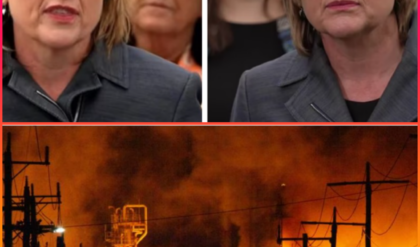
Just days before an inferno ripped through Viva Energy’s Geelong refinery, CEO Scott Wyatt and Victorian Premier Jacinta Allan announced it would boost output to meet Australia’s desperate fuel needs.
“They’ve upped the number of shipments that will be coming in here over the coming weeks, just as a prudent measure from the company,” Ms Allan said.
“The crude oil that we process here is not dependent on the Middle East; we take oil from much closer to home, and those supply lines are strong and intact,” Mr Wyatt added.
The joint press conference on March 27 was meant to reassure Victorians amid a fuel crisis.
But the strain on the ageing refinery – which one worker has described as a “major hazard facility” – may have proven too much.
The risk of accidents increases when refineries run at full capacity, according to MST Financial’s head of energy research Saul Kavonic.
“We are running our refineries really hard at the moment, which can raise the risk profile of accidents or things not going quite to plan,” Mr Kavonic told news.com.au.
Local fire authorities have confirmed that equipment failure caused the blaze at the Geelong facility, which supplies 10 per cent of Australia’s fuel and 50 per cent of the fuel used in Victoria.

FRV Assistant Chief Fire Officer Michael McGuinness said the fire started in the “mogas” section of the plant where motor gasoline was produced.
The blaze has been extinguished after burning for more than 12 hours.
Viva says it expects the damage to be primarily to production of gasoline and aviation gasoline.
“The extent of damage to the refinery is not yet known and will be investigated once it is safe to do so,” the company said in a statement.
“We anticipate that the impacts will be predominantly to the production of gasoline and aviation gasoline, however, the damage needs to be assessed and understood.”
Viva said there was no immediate impact to fuel supply.
The facility remained running on reduced production rates, and the company expected to replace lost production through its fuel import program.
“They’ve upped the number of shipments that will be coming in here over the coming weeks, just as a prudent measure from the company,” Ms Allan said two weeks ago. Picture: Supplied/9 News

Ronnie Hayden, Victorian branch secretary of the Australian Workers’ Union, said he was not surprised to see the refinery go up in flames.
“It’s a major hazard facility. It’s 70 years old,” Mr Hayden told The Australian Financial Review.
“Over the last few years, there have been a few significant incidents that our team have been working with the health and safety reps to try and resolve.
“So it’s not something that we expected, but it’s not something that we’re totally surprised about.”
It comes as Australia had been ramped up its domestic fuel production due to the Middle East oil shock, which is making imports, particularly from our Asian neighbours, expensive and difficult to secure.
“The timing of this really couldn’t be any worse,” Mr Kavonic said.
“This fire is going to wipe out 10 per cent of our fuel supply just when it’s most desperately needed in our history, right as the crunch point of the global fuel shortage is about to hit us.”
“This fire is going to wipe out 10 per cent of our fuel supply just when it’s most desperately needed in our history,” Saul Kavonic said. Picture: Lincoln Woolley

The country’s crude oil production has been in freefall for years.
It dropped to its lowest on record in February this year, down 90 per cent from a high of 1792 megalitres reached in July 2010, according to data released by the Energy Department on Wednesday.
Mr Kavonic said Australia would now be more reliant on imports than ever.
“This is going to exacerbate the government’s problem in procuring fuel, because in addition to the drastic efforts that are being taken to make sure the fuel we normally import continues to arrive here, we now need to go out and increase the amount of fuel we import by 10 per cent.”
He said the nation’s last functioning refinery, Ampol’s facility in Brisbane, could not make up the shortfall because it was already “working flat-out as it is,” and importing fuel to make up for the loss from Geelong would be “very costly” due to supply shortages in the global market.
“That fuel, if it’s available over the next month or so, in terms of cost it could be 30 to 60 per cent higher.”
The fire that started overnight was continuing to rage at Viva Energy’s Geelong refinery on Thursday morning. Source: Facebook/Community Pete

Macquarie University energy market expert Lurion De Mello said nine crude oil shipments bound for Geelong from the US, Malaysia, Brunei and Argentina might have to be diverted elsewhere.
“You can’t just put the fire out and kickstart operations again,” Dr De Mello said.
“If there’s a refinery-wide shutdown, what’s going to happen to all that oil that’s due to arrive that’s meant to go to the refinery? That’s going to put pressure on the other refinery at Ampol.
“I doubt there will be spare capacity, both refinieres were going full tilt.”
Dr De Mello said it would be difficult to secure fuel shipments from the international market to serve Victorians, and in the short-term they might need domestic help.
“Fuel supplies are very tight, and these scheduled shipments are already hard to get. So I don’t think in the near-term it will be easy if Victoria needs more fuel,” he said.
“There’ll have to be transportation over land from New South Wales or Queensland.”
He said the Geelong refinery had only recently undergone major maintenance work occurs every 5 years, while the Ampol refinery was past due for its own overhaul.
“The Ampol refinery has gone past its scheduled maintenance,” he said.
“Does that refinery also pose a risk? How far back can maintenance be pushed, is it not like doing a major service on your car?”
The surprising countries coming to our rescue
Thursday’s fire comes as Australia has resorted to importing diesel from all around the globe to meet our needs, with shipments scheduled from the UK, the US Gulf Coast, Oman and West Africa.
Shipping data shows one tanker dragging a massive cargo of diesel all the way from Southwold in the UK to Brisbane.
The vessel, traveling at about the same pace as a cyclist, will cover almost 29,000 kilometres and be at sea for 45 days before it reaches our shores on May 2.
Ordinarily, Australia imports diesel from Asian countries like South Korea and Singapore, which are much closer.
But refineries in those nations have been disrupted by the Iran war and we are now looking further afield to supply the 90 million litres per day required for freight, mining, agriculture and other crucial sectors.
Source: https://www.news.com.au/national/couldnt-be-worse-last-thing-australia-needs-as-geelong-refinery-burns-cutting-off-domestic-fuel-supply/news-story/6a60e8ba159a0499161b5dda7a543511
News

OUR HEARTS JUST GREW… — MasterChef judge Andy Allen welcomes first child with wife in emotional announcement
MasterChef Australia judge Andy Allen has welcomed his first child, a baby boy, with wife Alex. The reality TV star, 37, announced the happy news via a joint Instagram post with Alex on Friday, uploading a photo of the newborn asleep in his cot. ‘Jude…

THEY WERE COUNTING DOWN TO HIS BIRTHDAY… — Family holiday turns into nightma-re after father di-es suddenly overseas
A Central Coast family’s annual holiday with friends has ended in heartbreak after a father died suddenly in Thailand, just days before his birthday. Cameron Degan, a 44-year-old supervisor at a mining company, was found unresponsive by his wife Kylie at a resort…

“UNSPEAKABLE PAIN…” — Jordan Dawson’s emotional tattoo tribute to his late brother reveals a heartbreaking hidden detail that has left fans in tears
Jordan Dawson — captain of the Adelaide Crows — has tattooed the birth dates of his family members, including his parents (Marian and Tony) and his brother, on his ankle. Here are some details: Meaning: The tattoo is a heartfelt tribute…

MY HEART IS HEAVY… — Queen Mary makes first appearance after father’s death, but one subtle detail leaves many deeply unsettled
Queen Mary of Denmark has been seen in public for the first time since the death of her father John Donaldson. The Australian-born queen confirmed the sad news of his passing on Sunday, revealing Donaldson had died aged 84 in Tasmania….

“How could his family ever accept what happened in those final seconds?” — Police reveal chilling new details behind Easter motorbike tragedy that claimed a young father’s life in Paracombe
A young South Australian father killed in a horror motorbike crash in the Adelaide Hills has been identified as Nathan Watts, remembered by his family as “a man of his word.” Watts, 31, died alongside 47‑year‑old father‑of‑five Jarrid Cornwell when…

THE TRUTH THEY DIDN’T WANT YOU TO HEAR… — Harlan Goode EXPLODES After Sh0ck Idol L0ss
BRISBANE, Australia — Harlan Goode, the 18-year-old powerhouse vocalist from Redlands, Queensland, who captured hearts with his soaring ballads and commanding stage presence on Australian Idol 2026, is already charting his next chapter following a heartbreaking runner-up finish in the…
End of content
No more pages to load