The wind howled as if offended by her defiance.
It slammed into Lena’s small body from the side, nearly knocking her off her feet, snow stinging her face like thrown gravel. The pines surrounding her grandfather’s land bent and groaned, their branches cracking under the weight of ice, shedding white powder that fell in sudden, blinding curtains.
She tightened her grip on the man’s jacket.
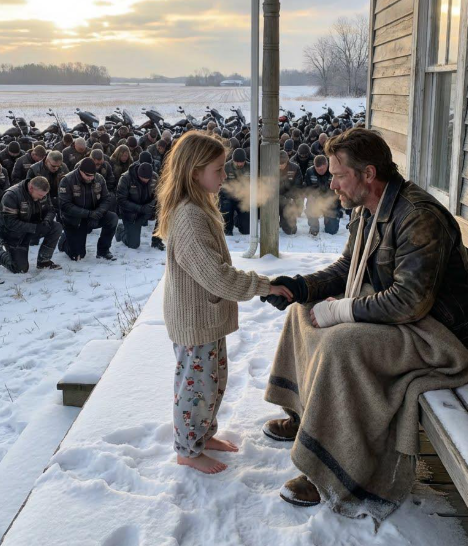
The leather was stiff with frost, the wolf skull stitched across his back split with age and ice, its white thread glaring against the black like teeth in the dark. Lena didn’t know what the symbol meant. She didn’t know that adults whispered about it. She only knew that the man attached to it was heavy — impossibly heavy — and that if she let go, the storm would finish what it had started.
“I’m not scared,” she told the wind, even though that wasn’t true. “I’m just cold.”
Her socks were soaked through, slush squelching with every step as she leaned back again, heels sliding, arms burning as she pulled.
The man groaned.
It was barely a sound, more vibration than voice, but it snapped through her like electricity.
“You’re alive,” Lena breathed, relief sharp and sudden. “See? You’re still here.”
His head lolled to the side, dark lashes crusted with ice. Blood had frozen along his beard, painting his skin a frightening gray-blue beneath it. One leg was twisted wrong, the boot bent at an angle that made Lena’s stomach tighten in a way she didn’t have words for yet.
She didn’t stop.
She dragged him another foot. Then another.
The gate loomed closer now — tall, iron, shrieking as it swung wildly in the wind. Beyond it lay the short stretch of yard to the house. Light glowed faintly in one window, warm and golden and impossibly far away.
Her grandfather was still asleep.
The thought made her pull harder.
Twenty minutes earlier, Lena’s biggest worry had been whether the cereal would get soggy before she finished it.
She remembered the spoon slipping from her fingers when she noticed the gate. It wasn’t supposed to be open. Her grandfather always locked it at night, always said the mountain didn’t forgive carelessness.
She had pressed her face to the cold glass, breath fogging the window as she squinted into the storm.
At first, she thought the dark shape was a fallen tree.
Then it moved.
Just a little.
Enough.
She hadn’t screamed. She hadn’t woken her grandfather. Some quiet instinct — older than fear — told her that time mattered more than permission.
She’d pulled on her socks, slipped into her boots without tying them properly, and pushed the door open.
The cold had swallowed her whole.
Now, as she crossed the threshold of the gate at last, Lena stumbled, knees buckling as the wind surged again. She fell forward this time, landing hard in the snow beside the man, pain flaring bright and fast in her shins.
She bit back a cry.
Crying wasted breath.
Instead, she crawled around him, planted her feet, and grabbed under his arms, bracing her back against the iron gatepost. She pulled with everything she had left.
Her vision blurred at the edges. Stars danced in front of her eyes.
“Almost,” she whispered, though she didn’t know if she was talking to him or herself. “We’re almost there.”
The man coughed suddenly — a wet, terrible sound — and snow-stiff fingers twitched weakly against her sleeve.
“Hey,” she said urgently, dropping to her knees beside his face. “You have to stay awake. My grandpa says if you fall asleep in the cold, you don’t come back.”
His eyelids fluttered. One eye cracked open, unfocused.
For a moment, she thought he was looking at her.
Then his gaze slid past, lost to something only he could see.
“…go,” he rasped, voice shredded. “Leave.”
Lena shook her head hard enough to make her ears ring.
“No,” she said firmly. “I already decided.”
She resumed pulling.
By the time she reached the porch steps, her hands were useless.
They no longer felt like part of her body — just stiff, aching things that barely obeyed her. Her breathing came in ragged gasps, each one burning her throat raw, but the porch was solid beneath her knees now, shelter cutting the wind just enough to make a difference.
She screamed then.
Not in fear — in triumph.
“GRANDPA!” she shouted, pounding the door with numb fists. “WAKE UP! PLEASE!”
The door flew open a heartbeat later, warm light spilling out, followed by a rush of heat so sudden it made her dizzy.
Her grandfather froze at the sight.
At his granddaughter kneeling in the snow.
At the bloodied man half-collapsed against the steps.
At the wolf skull on the jacket.
“Lena,” he said sharply, fear and disbelief colliding in his voice. “What have you done?”
She looked up at him, eyelashes crusted white, cheeks raw and burning.
“I saved him,” she said simply. “He was disappearing.”
The ambulance came faster than anyone expected.
Word traveled quickly in a town this small — especially when the name whispered into radios carried weight.
Elias Crowe.
The man everyone thought was dead.
The man who had vanished fifteen years ago after a fire, a fight, and a chain of rumors no one wanted to untangle.
Men stood at the edges of the yard as paramedics worked, faces pale, voices hushed. Some crossed themselves. Some stared at the jacket like it might bite.
Elias never regained full consciousness on the stretcher.
But his hand closed weakly around Lena’s sleeve as they lifted him, fingers trembling.
She didn’t pull away.
He survived the night.
The doctors said it was impossible. Hypothermia, blood loss, shattered leg — any one of them should have ended him. Together, they should have been fatal.
But he lived.
And when he woke, days later, in a hospital room washed in sterile light, the first thing he asked for was the child.
“She’s six,” the nurse told him gently. “You shouldn’t—”
“She saved my life,” Elias said hoarsely. “I need to see her.”
Lena stood by the hospital bed, feet swinging nervously above the floor, her hands wrapped around a cup of hot chocolate that steamed between them.
Elias looked smaller without the jacket, older too. His hair was shot through with gray, his face lined and tired. But his eyes — sharp, dark, haunted — fixed on her with unmistakable clarity.
“You didn’t have to do that,” he said quietly.
She frowned. “Yes, I did.”
A corner of his mouth twitched.
“You knew who I was?”
She shook her head. “You were cold.”
Silence stretched between them, heavy with things Lena couldn’t name.
“I was supposed to die out there,” Elias said finally. “That storm was… finishing something.”
Lena tilted her head. “My mom says storms don’t finish things. They just move them.”
His throat bobbed.
“What do you want to be when you grow up?” he asked suddenly.
She thought about it. “I don’t know yet.”
He nodded slowly. “You already are.”
The town never fully knew what to do with the truth.
With the man they’d buried in rumor walking its streets again — limping, quieter, changed. With the child who’d pulled him back from the edge.
Some said it was foolish. Dangerous.
Some said it was a miracle.
Elias stayed.
Not because he was forgiven — but because he no longer ran.
And every winter after that, when the storms came screaming down the mountain, Lena Whitaker would stand at the window and watch the snow fall, knowing something most adults forgot too easily:
That sometimes, the smallest hands are the only ones brave enough to reach into the cold — and pull someone back.