Williams’s laugh bounced off the berm and came back thinner, like it had reconsidered itself midair. Twenty dollars changed hands with a little ceremony. Someone whistled. Someone else muttered something about wasting range time.
Staff Sergeant Thompson didn’t laugh. He studied me the way men study weather they don’t like—eyes narrowed, jaw set, already preparing excuses.
“You sure you want this, Martinez?” he asked. “We’re zeroed for work, not charity.”
“Yes, Sergeant.”
He paused, just long enough to make it feel like a favor. “Five hundred meters. One round. You get a spotter. Miss wide and we’re done.”
Williams slid his rifle off the rest and held it out like a dare. The .338 Lapua felt familiar in my hands—weight honest, balance true. Rifles tell you things if you listen; this one said it had been loved, maybe even feared.
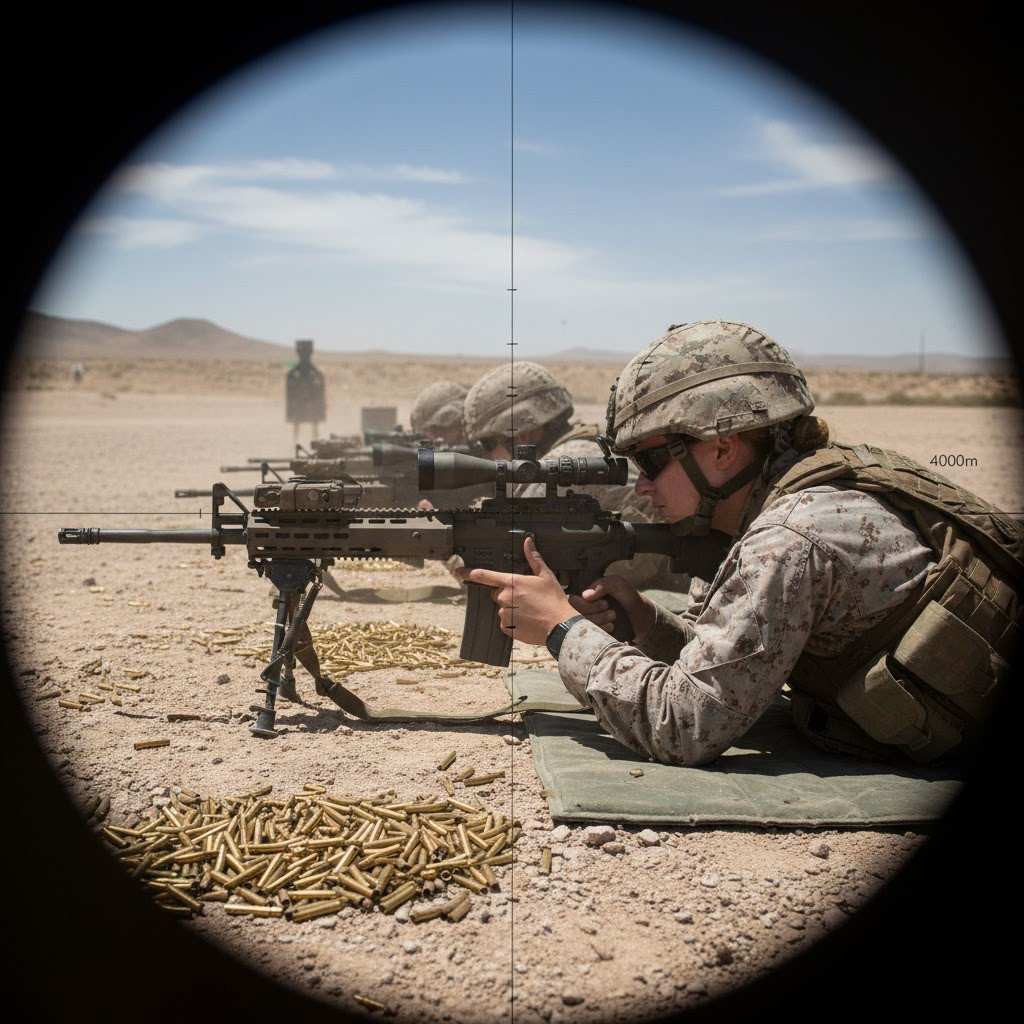
I settled behind the glass. The world snapped into lanes and lines. Heat shimmered. Mirage braided itself into ribbons that bent left then right, arguing with each other. Wind flags along the range told a half-truth. The truth lived higher, where the air forgot the ground existed.
“Wind’s quartering left,” Williams said, smug. “Call it point-five mil right.”
I breathed and waited. Granddad’s voice rode the breeze like it always did: Look until you’re seeing. I watched the grass at three distances, the dust ghosts at eight, the mirage at twelve. The wind wasn’t quartering. It was playing.
“Point-two right,” I said. “High by a click.”
Williams snorted. “Sure.”
I married my breath to the trigger and let the shot leave when it was ready. The rifle recoiled into me like a handshake. Six heartbeats later, steel rang—clear, surprised.
For a second, no one spoke. Then someone swore.
“That was luck,” Williams said quickly. “Do it again.”
Thompson’s eyes were on the target, then on me. “Move it to eight hundred,” he said. “Same rules.”
They shifted the steel. The sun slid lower, thickening the air. I adjusted, listening to the range hum. The wind did a small, mean thing at seven hundred, a pocket that tugged bullets down and left like it wanted company.
“Call it,” Thompson said.
“Hold center,” I replied. “Let the wind finish its sentence.”
The shot flew. The ring came back slower this time, heavier. Eight hundred sounded like a church bell underwater.
The laughter didn’t come back at all.
Thompson rubbed his jaw. “Thousand.”
At a thousand, the bullet became a traveler in truth. I fed it a road that told no lies—elevation true, wind honest, breath patient. When steel rang again, someone behind me said my name like a question.
“Who taught you?” Thompson asked, quieter now.
“My grandfather,” I said. “On a ranch.”
“Competition?”
“No, Sergeant.”
He nodded once, then surprised everyone. “Fifteen hundred.”
A murmur rippled through the line. Fifteen hundred was a flex distance, a place for stories and qualifiers. Thompson pulled his own rifle close, then stopped. He looked at the .338 in my hands and made a decision that would follow him.
“Spotter’s mine,” he said.
We lay side by side. The world narrowed. The wind braided itself thinner, sly as a grin. Thompson called corrections as he saw them; I listened, sifted, discarded half.
“Wind’s changing,” he said.
“It is,” I agreed. “At a thousand. It’ll be steady again past twelve.”
He glanced at me. “You’re sure.”
“Yes, Sergeant.”
The bullet went. Time stretched. Six seconds felt like a held breath in a chapel. When the steel sang at fifteen hundred, the sound carried a little sorrow with it—as if the range knew something had shifted and would not be unshifted.
Silence fell, then applause broke out awkwardly, the way men clap at funerals.
Thompson sat back. “Again.”
I shook my head. “No, Sergeant.”
That landed harder than the hit.
“You don’t want to prove it wasn’t a fluke?” Williams said, trying for bravado.
“I don’t need to,” I replied. “And the wind’s tired of being asked.”
Thompson stared at me for a long moment. “What do you want, Martinez?”
I thought of Saturdays in my grandfather’s palm. Of patience teaching distance. Of being told, all my life, to pick up the casings and keep my eyes soft.
“A chance,” I said. “The same one everyone else gets.”
He exhaled through his nose. “You’ll test.”
I nodded. “Yes, Sergeant.”
They tested me the way institutions test weather—charts, checklists, boxes meant to hold a person still. I passed them clean. The psych eval took longer; the questions circled like birds that didn’t intend to land.
“Why do you shoot?” one asked.
“To tell the truth,” I said.
He blinked. “About what?”
“Distance.”
They let me in.
Training changed shape around me. Some days were long and bright, the range generous. Other days were mean, wind knifing down draws, mirage laughing. Thompson watched more than he talked. Williams stopped betting.
On deployment, the world turned sharp-edged. We learned the sound of different sands, the way heat could lift a bullet like a promise and drop it like a lie. We learned to read cities the way ranchers read sky.
The shot came at dawn, always dawn. Two rooftops, a breath of wind from the river, a target who thought distance was safety. Thompson was my spotter this time. He trusted my calls now, trusted the way I listened.
“Send it,” he said.
The bullet traveled six seconds and found the truth waiting. When it was done, Thompson didn’t celebrate. He wrote the numbers down carefully, like a man keeping a ledger.
Later, in the quiet, he said, “You were only picking up casings.”
I smiled. “That’s all you wanted stamped into the moment.”
He nodded. “I was wrong.”
So were a lot of people. The wind didn’t care.
Years later, on leave, I went back to the ranch. The fence leaned the same way it always had. The wind never got bored. I lay prone on the old hill and watched the valley breathe.
“Look until you’re seeing,” I said aloud.
The world sharpened. Distance told the truth.