The snow had stopped falling sometime before dawn, leaving the Ardennes forest locked in a brutal, crystalline stillness. Every branch was iced white, every shadow sharp and unforgiving. It was the kind of quiet that didn’t comfort—it warned. War never truly slept. Even when the guns paused, it lingered in the air, heavy and watchful, waiting for someone to move first.
Private James Miller lay face-down behind a fallen pine, his breath shallow, his fingers numb around the stock of his M1 Garand. Frost clung to his helmet and eyebrows. His unit had been moving for days without proper rest, pushing through terrain that seemed designed to break men down piece by piece. The orders had been simple enough on paper: advance, clear, survive. Out here, those words felt hollow.
He had been twenty-two when he crossed the Atlantic. Twenty-three now. And already, he felt decades older.
The shot came from nowhere.
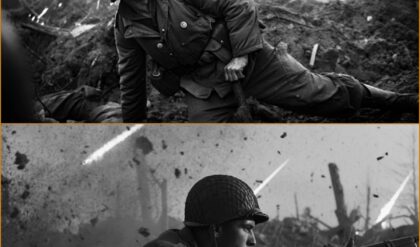
A sharp crack split the air, followed by a pain so sudden and fierce it stole his breath. His leg buckled beneath him as if it no longer belonged to his body. James screamed despite himself, the sound tearing free before he could stop it. His rifle skidded across the snow as he collapsed, hands clawing uselessly for purchase.
He tried to crawl.
His leg didn’t respond.
Warmth spread beneath him, dark and frighteningly fast, steaming against the frozen ground. German fire erupted around him—short, controlled bursts snapping into tree trunks, chewing bark into splinters. James pressed his face into the snow, biting down hard to keep from crying out again.
This is it, he thought.
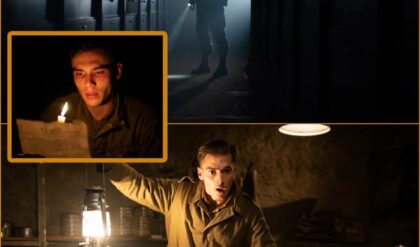
He pictured his mother’s kitchen in Ohio. The smell of coffee. The way the radio hummed softly in the mornings. He wondered if she’d already received the letter he’d written three weeks earlier, the one where he’d lied and said he was fine.
Minutes passed. Or seconds. Time lost its shape.
The gunfire slowed, then stopped.
Silence returned—but it felt different now. Closer. Watching.
James forced himself to lift his head. His vision blurred, the forest spinning slightly. That’s when he saw the boots.
They were black, polished despite the mud and snow, stepping carefully through the trees. A German soldier emerged from the fog, rifle raised, eyes scanning the ground with practiced calm. He couldn’t have been much older than James. Maybe mid-twenties. His face was pale, jaw tight, breath forming small white clouds in the air.
James’s heart slammed against his ribs.
He tried to reach for his rifle, but his arm trembled and failed him. The German soldier saw the movement instantly. His rifle snapped toward James’s chest.
For a moment, neither of them moved.
This was how it ended, then. Not in a heroic charge. Not saving anyone. Just bleeding out in the snow, staring down the barrel of an enemy gun.
The German soldier’s finger rested on the trigger.
Then he hesitated.
His eyes dropped—not to James’s face, but to the leg. To the blood soaking through the torn fabric. To the way James’s hands shook, not with fear, but with shock.
Slowly, cautiously, the German stepped closer.
James squeezed his eyes shut.
The shot never came.
“Don’t move,” the soldier said, his English rough but clear. “Please.”
James opened his eyes again, confused. The rifle was still trained on him, but the soldier’s voice lacked cruelty. If anything, it sounded strained—like the words had been forced out against something inside him.
“I could shoot you,” the German continued. “That is what I am supposed to do.”
He paused.
“But I will not.”
James swallowed, his throat dry. “Why?” he whispered.
The soldier didn’t answer right away. He glanced over his shoulder, deeper into the forest, listening. Then he lowered his rifle and slung it across his back in one smooth motion that made James’s breath catch.
“My name is Lukas,” he said quietly. “I was a medical student before the war.”
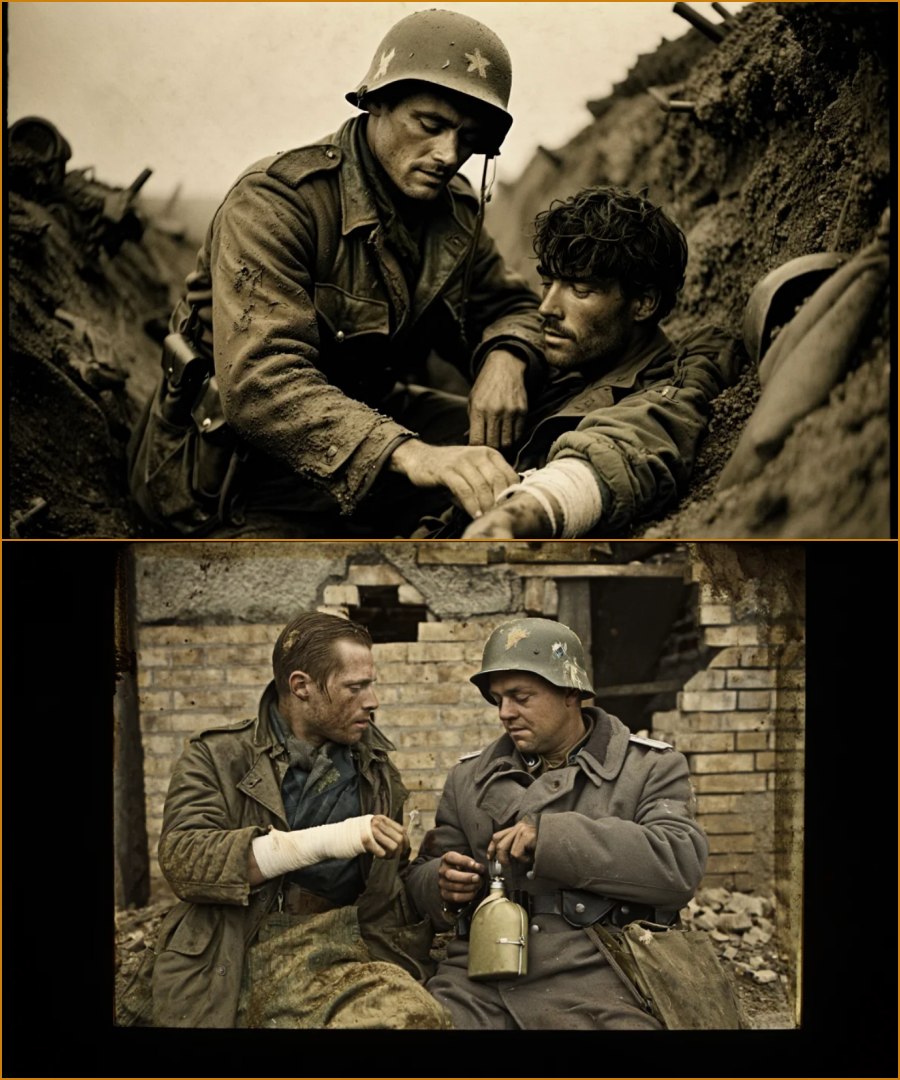
He knelt beside James, movements quick and practiced, tearing open a pouch at his belt. “Your leg,” he said. “Bullet passed through. That is good. But you are losing too much blood.”
“This is a trick,” James muttered weakly. “You’re going to take me prisoner.”
Lukas met his eyes. “If I do that, my unit will shoot you anyway. Or you will freeze before we reach them.”
He pressed a bandage hard against the wound. James cried out, the pain white-hot.
“Stay with me,” Lukas said firmly. “Do not sleep.”
As Lukas worked, James noticed his hands. They were steady. Gentle. The hands of someone who had done this before—not for killing, but for saving.
“Why help me?” James asked again, his voice cracking.
Lukas exhaled slowly. “Because yesterday, I helped carry the body of a boy who could not have been more than eighteen. He was wearing your uniform.”
He tightened the bandage. “Because this morning, I woke up and realized I no longer know how many deaths it would take before I stop feeling anything at all.”
Footsteps echoed faintly in the distance.
Lukas froze.
He leaned closer, his voice urgent. “Listen to me. In five minutes, my patrol will pass through here. If they find you alive, they will kill you.”
James’s eyes widened. “Then go. You’ve done enough.”
Lukas shook his head. “No.”
He scanned the forest, then made a decision that would haunt him for the rest of his life.
“Can you move your arms?” he asked.
James nodded weakly.
“Good. When I leave, you will count to sixty. Then you will crawl—slowly—toward that ravine.” He pointed through the trees. “There is cover. Your men may find you.”
“And you?” James asked.
Lukas stood, lifting his rifle once more. His face was tight now, resolved.
“I will fire two shots into the air,” he said. “They will think I found you and you escaped. They will be angry. But alive.”
He hesitated, then added quietly, “If anyone asks, I never saw you.”
They locked eyes one last time—two soldiers on opposite sides of history, bound for a brief moment by something older than war.
“Thank you,” James said.
Lukas nodded once. Then he turned and disappeared into the trees.
Seconds later, two rifle shots cracked the silence.
James counted.
One. Two. Three.
Each number felt heavier than the last. When he reached sixty, he began to crawl, dragging his wounded leg behind him, teeth clenched against the pain.
Hours later, American medics found him half-conscious in the ravine, barely alive.
James survived the war.
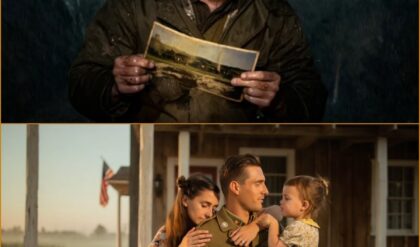
Years passed. He returned home. Built a life. Had children. Grandchildren. But the memory of that frozen morning never left him—the enemy who chose mercy, the man who saved his life at the cost of his own safety.
Decades later, when James was old and his hands shook the way Lukas’s never had, he told his family the story.
“War tells you who your enemy is,” he said softly. “But it doesn’t get to decide who you are.”
And somewhere, in a forest that has long since grown quiet again, the snow remembers both of them.