Above the town rose Timberline Ridge, a jagged spine of rock and pine that caught storms the way a net catches birds. Eli had seen it from the apartment window his whole life, a dark wall against the sky. That night, it felt closer—looming, listening.
He climbed because his feet kept moving. Because stopping meant turning back. Because the wind, strange as it was, didn’t tell him he was useless.
Snow climbed his calves. The world narrowed to breath and pain and the steady thump of his heart. Eli stumbled, fell, stood again. When he cried out—once, thin and surprised—the sound was swallowed whole.
Somewhere on the ridge, the storm shifted. The wind bent low, curling around him, not pushing him back but guiding, as if to say: This way.
He followed.
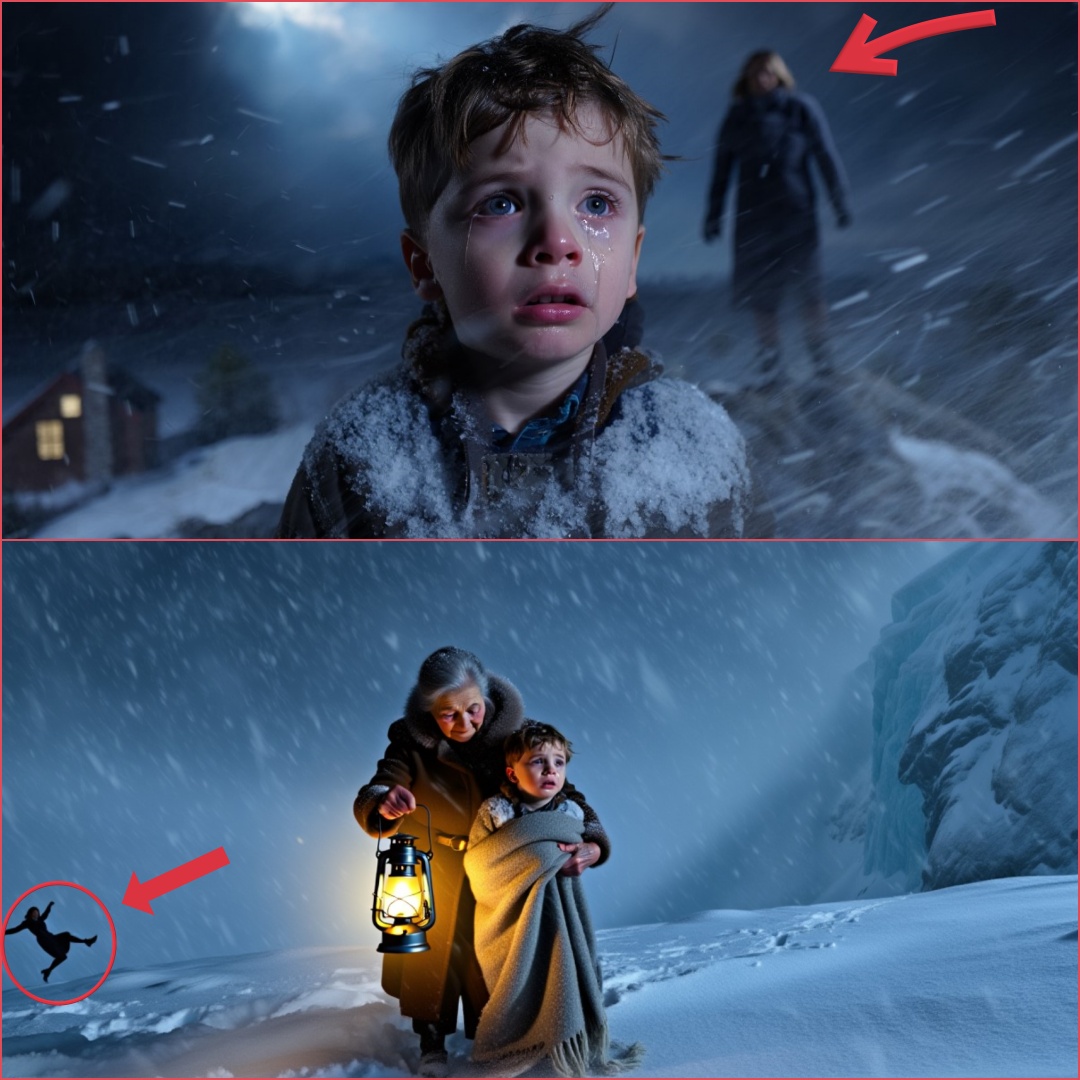
3. The Cabin That Shouldn’t Have Been There
Eli found the cabin by accident. Or fate. Or because the mountain had decided a child did not deserve to die alone.
It sat in a bowl of trees, roof bowed under snow, a single window dark. Eli pressed his hand to the door. It opened with a groan, like an old man waking.
Inside, the air was colder than outside, but it was still. There was a table, a chair, a hearth with blackened stones. Eli crawled toward the fireplace and curled into a knot so small it seemed impossible he was real.
“I just want someone to love me,” he whispered again, to the walls this time. To the mountain. To whoever might be listening.
The storm roared back—then softened. Snow slid from the roof with a sigh. The wind fell quiet enough that Eli could hear his own breath.
He slept.
4. Deborah’s Morning
Deborah Whitlock woke late. Her head pounded, her mouth sour. She padded through the apartment, irritated by the mess, by the silence.
“Eli,” she snapped. “Get up.”
No answer.
She checked the couch. The corner. The bathroom. Her irritation sharpened into something else—a cold, prickling fear she refused to name. She noticed the door, ajar. The wind had pushed it open, she told herself.
Outside, Silver Creek lay buried in white. The storm had been worse than the radio warned.
Deborah stood in the doorway, robe pulled tight, and stared at the footprints leading away—small, bare, already filling in. For a moment, she felt nothing at all. Then she slammed the door and reached for the phone.
She did not cry.
5. The Search
By noon, the town was moving. Volunteers gathered at the fire station. Snowmobiles growled awake. A sheriff named Tom Alvarez studied the map and circled Timberline Ridge.
“A four-year-old,” he said quietly. “Barefoot.”
People shook their heads. Someone crossed herself.
They searched until dusk. They searched until their hands went numb and their hope thinner than breath. The storm returned at sunset, angry now, as if offended by the intrusion.
At midnight, Alvarez called it. “We’ll start again at first light.”
Deborah watched from the edge of the crowd, arms folded. When the deputy asked questions, she answered flatly, efficiently. She spoke of spilled milk. Of a tantrum. Of a door she must have forgotten to lock.
No one noticed the way she never said his name.
6. The Mountain Listens
Eli woke to warmth.
Not fire—there was none—but a pocket of calm in the cabin, a hush that held. His hands tingled. His feet burned and then didn’t.
A sound came through the walls, not wind this time but something deeper, like the mountain clearing its throat.
Eli sat up. He was not afraid. He felt… held.
Outside, the storm broke apart. Snow fell gently, flakes drifting like feathers. In the quiet, Eli heard footsteps.
He opened the door.
A man stood there in a coat crusted with ice, beard white with frost. His eyes were kind and very old. He knelt so they were level.
“Hey there, little one,” the man said. “I’ve been looking for you.”
Eli studied his face. “Are you mad?”
The man smiled. “No.”
“Are you going to send me back?”
The man’s smile faded. “Not tonight.”
He wrapped Eli in his coat. Together, they walked down the ridge, the path opening ahead of them as if it had always been there.
7. Found
They found Eli at dawn.
A volunteer named Marisol spotted the cabin first. Smoke rose from the chimney—thin, impossible. When they burst inside, they found Eli asleep by a fire that burned low and clean, though no one could later explain where the wood had come from.
The old man was gone.
Eli woke to hands and voices and tears. He reached for Marisol’s sleeve and held on like he might float away.
“Did I do something bad?” he asked.
“No,” she said fiercely. “No, sweetheart.”
The sheriff radioed the news. Cheers broke out at the fire station. Someone laughed. Someone else cried.
Deborah arrived an hour later. She stood in the doorway and stared at the boy wrapped in blankets, cheeks flushed with warmth.
“There you are,” she said. “You scared everyone.”
Eli did not look at her.
8. The Price Comes Due
What happened next did not make headlines, not at first.
A doctor examined Eli and frowned. Old bruises bloomed like ghosts beneath his skin. Scars mapped places a child should not carry pain. A nurse asked gentle questions and wrote everything down.
The sheriff asked harder ones.
Deborah’s story shifted. Details slipped. Words tangled. The checks from Daniel told a story too—one of neglect, of nights unaccounted for.
Daniel flew home in a panic. When he saw his son’s arms, he fell to his knees.
“I didn’t know,” he sobbed.
Eli watched from the doorway, quiet as ever. The storm had taught him patience.
Child Protective Services stepped in. An investigation unfolded like a curtain being pulled back, inch by inch. Neighbors remembered things. Teachers spoke up. A clerk at the liquor store testified about the wine.
Deborah Whitlock was charged. The town exhaled.
But the mountain wasn’t done.
9. The Cabin’s Secret
A week later, the cabin burned down.
No one was inside. No one was hurt. The fire started clean and ended clean, leaving nothing but stone and ash.
The sheriff stood in the snow and frowned. “Lightning,” someone said, though the sky was clear.
Marisol looked up at Timberline Ridge and felt a shiver. She thought of the old man, though she had never seen him. She thought of the way the wind had bent that night, just so.
“Sometimes,” she said softly, “places remember.”
10. Learning to Speak
Eli went to live with a foster family first—a couple with warm hands and a dog that slept at his feet. Later, Daniel earned his way back into his son’s life, one promise at a time.
Eli did not speak much at first. Words had been dangerous once. But storms came and went, and he learned they did not always mean harm.
On his fifth birthday, it snowed.
Eli stood at the window and watched the flakes drift. He pressed his palm to the glass—not to beg this time, but to greet.
“Thank you,” he whispered.
Outside, the wind stirred, gentle as a breath, and carried the words away.
11. Epilogue: What the Town Says Now
In Silver Creek, people still talk about that night. They say the mountain saved a boy. They say the storm listened.
Some say justice arrived dressed as weather.
Eli grows. He laughs. He learns the names of things. When he hikes Timberline Ridge with his father years later, he pauses near a bowl of trees where nothing stands anymore.
“Did someone live here?” he asks.
Daniel shakes his head. “Not that I know of.”
Eli smiles, small and secret.
The mountain watches.