Every morning was the same.
The alarm rang at 5:30 a.m., the sky still dark, the city half-asleep. I’d pull on my worn jacket, unlock the café at the corner of Maple and 8th, and breathe in that familiar smell of yesterday’s coffee grounds and cleaning solution. By 6:00, the lights were on. By 6:15, the first pot was brewing.
My life had become a loop — cups lined up, tables wiped down, pastries arranged just right. Smile. Repeat. The bell above the door chimed, and regulars drifted in like clockwork.
That’s why I noticed him.
He came in at exactly 7:15 a.m. every day.
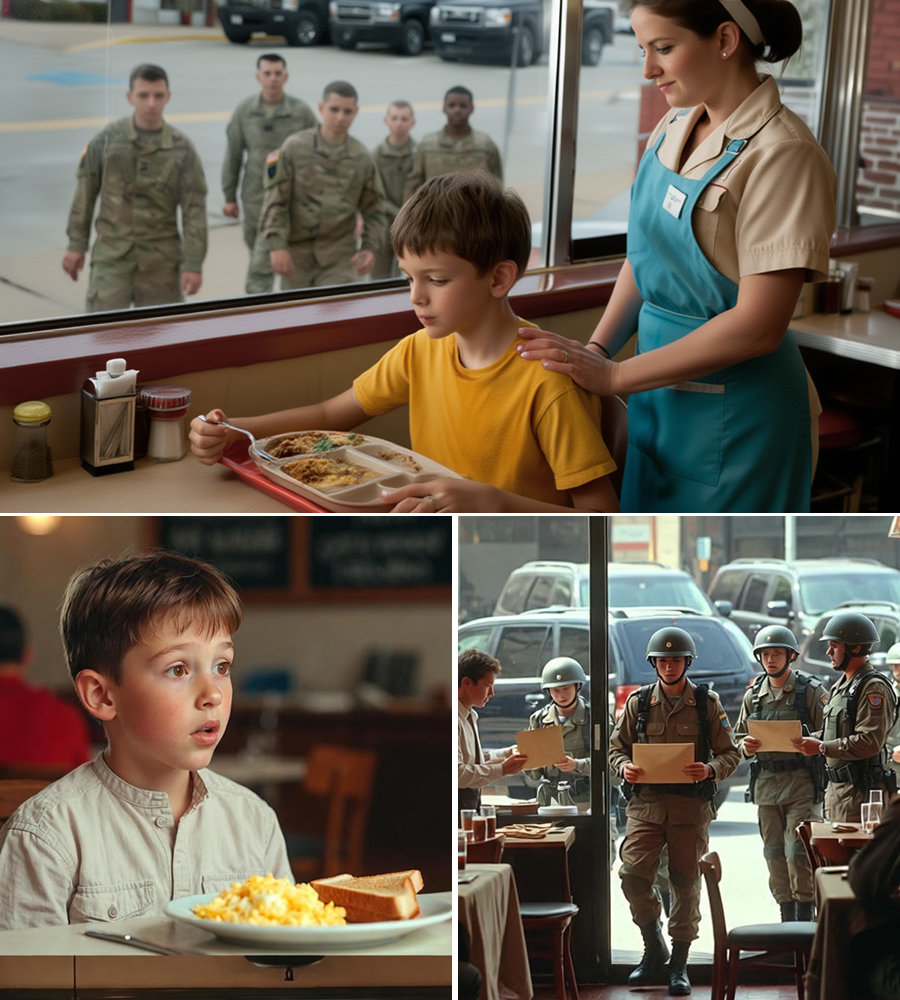
A small boy. Ten years old, maybe. Too thin. His backpack looked far too heavy for his narrow shoulders, the straps fraying, one zipper missing. He always sat in the farthest corner booth, the one half-hidden behind a fake potted plant.
And he ordered nothing.
Just a glass of water.
At first, I thought maybe he was waiting for someone — a parent, an older sibling. I kept glancing over, expecting an adult to appear. No one ever did.
Day after day, he came alone.
He never played on a phone. Never brought a book. He just sat there quietly, hands folded in his lap, eyes drifting toward the kitchen whenever food came out.
Management was strict. No loitering. No freebies. This café ran on thin margins, and I needed this job.
So for the first two weeks, I did nothing.
I hated myself for it.
On the fifteenth morning, something inside me snapped.
I’d made pancakes for the breakfast rush, flipping them on the grill, watching the steam rise. When I turned around, I saw him in his corner booth again, staring at his glass of water like it was all he deserved.
Without thinking, I grabbed a plate.
I walked over, heart pounding.
“Accidentally made too many,” I said casually, placing the pancakes in front of him. “They’ll just go cold.”
He froze.
Slowly, he looked up at me — really looked at me — as if he were trying to decide whether I was real.
Then he whispered, “Thank you.”
Just two words. But the way he said them — careful, deliberate — made my throat tighten.
From that day on, I fed him every morning.
Sometimes pancakes. Sometimes eggs and toast. Once, when we had leftovers, I brought him a muffin wrapped in a napkin “for later.” I made sure management never saw. I timed it carefully. I lied when I had to.
He never asked for anything. Never complained. Never took more than he needed.
He didn’t talk much, but little things slipped out over time.
He liked dinosaurs. He hated loud noises. He was very good at math. When I asked where his parents were, he just shrugged and said, “They’re busy.”
I didn’t push.
Some mornings, he smiled. Other mornings, he looked tired beyond his years. But every single day, at exactly 7:15, he showed up.
Until he didn’t.
The bell never rang.
7:20 passed. Then 7:30.
I kept wiping the same clean counter, pretending not to stare at the door. A knot formed in my stomach — worry, mixed with guilt. Had I scared him off? Had management said something? Had something happened to him?
Then I heard it.
Engines.
Not one. Not two.
Four.
Black SUVs rolled up outside the café, their windows dark, their presence heavy and wrong against the quiet morning street.
The café fell silent.
Men stepped out — uniformed, composed, unmistakably military. They moved with purpose, scanning the area before entering.
The bell chimed.
No one spoke.
One of them approached the counter. He didn’t look angry. He didn’t look kind. He looked… careful.
“Are you the one who’s been feeding the boy?” he asked quietly.
My hands went cold.
“I— I don’t—” My voice caught.
He slid a sealed envelope across the counter.
“Please read this.”
The moment I saw the emblem stamped in the corner, my knees weakened.
I opened it.
The first line stole the breath from my lungs.
Thank you for taking care of our son.
The plate slipped from my hands and shattered on the floor.
The letter explained everything.
The boy’s name was Elias.
His parents weren’t “busy.” They were deployed overseas — elite military officers on a classified mission. Their identities had to remain secret. So did his.
There had been threats. Serious ones.
Elias had been placed in a safe house nearby, monitored discreetly. The café visits weren’t part of the plan. They were his choice.
“He said it was the only place he felt normal,” the letter read.
“He said you treated him like a human being, not a risk.”
My vision blurred as I read on.
That morning, a credible threat had surfaced. The operation had been compromised. Elias had been relocated immediately — for his safety.
The men weren’t there to arrest me.
They were there to thank me.
One final line was handwritten at the bottom, the letters uneven but familiar.
I won’t forget the pancakes. Or you. — Elias
I looked up, tears spilling freely now.
“Is he… safe?” I asked.
The officer nodded. “Because of people like you, yes.”
They left as quietly as they’d arrived.
The café slowly returned to life. Orders were placed. Coffee poured. The bell chimed again and again.
But the corner booth stayed empty.
Weeks passed.
Then months.
Sometimes I still catch myself glancing at the door at 7:15.
On my last day at that café — the day I finally moved on — I found something taped under the counter.
A small, folded drawing.
A café. A smiling stick figure behind the counter. And a boy in the corner booth, holding a plate of pancakes.
On the back, four simple words:
You saved my mornings.
I still don’t know where Elias is now.
But every time I feed someone who looks forgotten…
I think of him.