From above, the Pacific looks harmless.
A sheet of blue silk stretching endlessly toward the horizon.
But at 80 meters, silk becomes stone.
Cold. Crushing. Unforgiving.
Down there, mistakes don’t get second chances.
And betrayal?
Betrayal sinks fast.
Part 4: The Hunter in the Dark
The spare cylinder hissed steadily as I secured it to my harness. My pulse began to slow. Panic wastes air. Anger sharpens it.
Above me, Marcus’s silhouette drifted upward in disciplined increments—ten meters per minute, just like the manuals say. He was following decompression protocol carefully.
Of course he was.
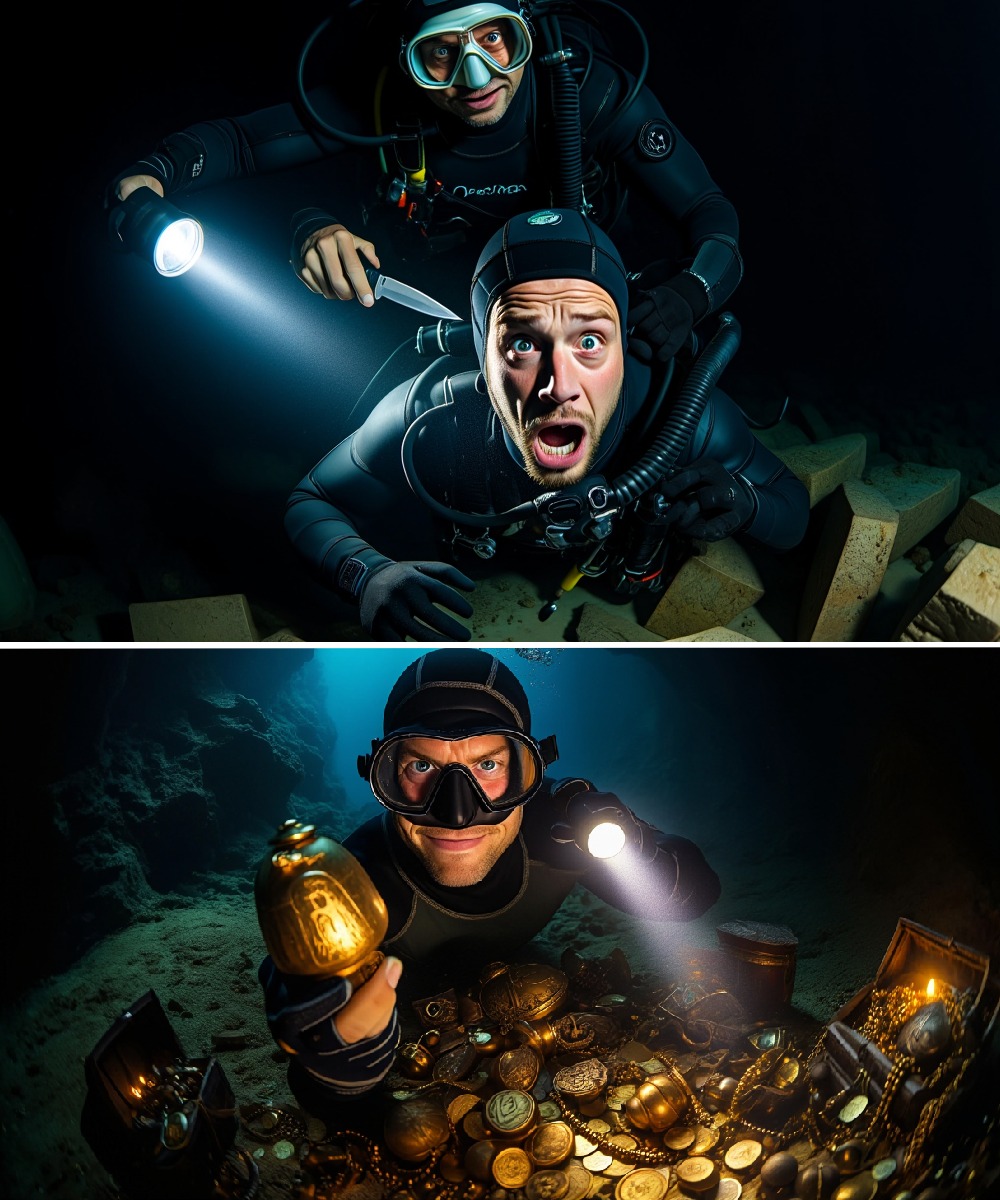
Marcus never broke rules unless greed told him to.
The lift bags carrying the iron chest floated above him like pale ghosts rising toward profit.
He believed I was already dead at the bottom of the trench.
That was his second mistake.
The first was underestimating how long I could function without air.
The second was forgetting who trained him to do it.
I killed my primary light.
Darkness swallowed me whole.
In deep water, light gives away position. Shadows are protection.
I angled myself slightly below and behind him, using the trench wall as cover. My smaller backup torch flickered once, then steadied—just enough illumination to track his fins slicing through black water.
At 70 meters, nitrogen narcosis starts whispering lies in your ear.
At 80, it sings to you.
Marcus had always been more susceptible to it than I was. I’d seen it during training dives—his movements just slightly delayed, judgment a fraction off.
Greed plus narcosis.
Bad combination.
I ascended faster than protocol allowed—but not recklessly. I knew my body. I calculated the risk.
If I died from decompression sickness later, so be it.
At least I wouldn’t die forgotten in a trench.
Part 5: The First Strike
At 65 meters, I reached him.
He didn’t see me.
I grabbed his fin.
He jolted violently, spinning around.
His eyes widened behind the mask.
Shock.
Pure, animal shock.
Dead men don’t grab your leg.
His regulator bubbled faster—breathing rate spiking.
Air consumption increasing.
Good.
I didn’t attack his throat.
I didn’t pull his mask.
That would have been rage.
Instead, I did something worse.
I clipped my spare cylinder’s tether onto his buoyancy compensator.
He froze, confused.
I leaned close so he could see my eyes clearly through the glass.
Then I pointed upward.
And shook my head slowly.
No.
You’re not going up alone.
Marcus tried to kick free, but I locked onto him, controlling our ascent rate by venting small bursts from his vest.
He reached for his knife again.
I anticipated it.
I grabbed his wrist and twisted—hard.
The knife spun into the darkness, vanishing instantly.
Out here, losing a tool is like losing a limb.
His breathing grew ragged.
I could see calculation returning to his eyes.
He realized something terrifying:
If he bolted to the surface too fast to escape me, nitrogen bubbles would form in his blood.
The bends.
Paralysis.
Stroke.
Death.
If he fought me, we’d both burn air faster.
If he cut me loose again, I’d just drag him down.
We were linked now.
Brothers again.
Just not the way he planned.
Part 6: The Long Ascent
At 50 meters, we hit our first decompression stop.
He tried to signal.
I ignored it.
I forced him to hold position.
Three minutes.
His chest rose and fell violently.
I stayed calm.
Because calm wins underwater.
I leaned close to his ear and activated my backup comm.
Static crackled—weak, but functional.
“You forgot something, Marcus,” I said quietly.
His eyes flicked to me.
“You never betray the guy who knows exactly how much air you’ve got left.”
I tapped his pressure gauge.
He looked down.
His needle was falling faster than it should.
When he cut my hose, he’d damaged his own secondary line slightly—tiny leak. Not catastrophic.
But at this depth?
Every bubble matters.
He hadn’t noticed.
I had.
His eyes filled with something I hadn’t seen before.
Not greed.
Not anger.
Fear.
Real fear.
Part 7: Surface Tension
By 20 meters, his air reserve was dangerously low.
He tried to signal for my spare cylinder.
I let him wait.
Ten seconds.
Twenty.
Long enough for him to understand the weight of what he’d done.
Then I handed him the regulator.
Because I’m not a murderer.
And because watching him live with it would hurt more.
We completed the final decompression stop in silence.
Above us, sunlight returned as a faint silver shimmer.
The lift bags had already surfaced.
The chest was probably being hauled onto the research vessel.
No one knew what had happened below.
Not yet.
When we finally broke through the surface, the world felt loud.
Waves slapped against our suits.
The boat crew shouted.
“Where’s the delay?” one of them yelled. “We almost thought—”
Marcus tore off his mask first.
He looked at me.
Waiting.
Wondering what I’d say.
I removed mine slowly.
“Equipment malfunction at depth,” I called out calmly. “We had to resolve it.”
The crew nodded.
It happens.
Out here, things fail all the time.
People rarely question the ocean.
Part 8: The Real Consequence
Back on deck, Marcus avoided my eyes.
The chest was being secured. Cameras flashing. Company reps already smiling at projected profits.
No one noticed Marcus’s trembling hands.
Later, in the quiet of the equipment bay, he cornered me.
“Why didn’t you tell them?” he demanded.
“Tell them what?” I asked evenly.
“That I—”
I stepped closer.
“You cut my air line,” I said softly. “At 80 meters. For money.”
His jaw tightened.
“You tried to kill me.”
He swallowed.
“So why didn’t you report it?”
Because here’s the thing about divers.
If word spreads that you sabotage your partner underwater, you’re finished.
No company hires you.
No crew trusts you.
You’re done in every ocean on earth.
I held his gaze.
“You don’t need me to report you,” I said quietly. “You’ll never dive professionally again.”
His eyes flickered.
He understood.
Every dive from now on, he’d remember.
Every time he strapped on a tank, he’d feel phantom hands grabbing his fin in the dark.
Trust is oxygen down there.
And he’d burned his supply.
I turned to leave.
“One more thing,” I added.
He looked up.
“If I’d wanted you dead… we wouldn’t have made it past 60 meters.”
I walked away.
Epilogue: The Weight of Water
The company investigation later cited “minor equipment anomalies.”
Marcus resigned two weeks after the mission.
No explanation given.
As for the treasure?
It made headlines.
Recovered artifacts from a 19th-century wreck valued in the millions.
People commented about history, preservation, profit.
No one talked about the real story.
About how deep water strips men down to their rawest form.
Up here, betrayal is messy.
Down there, it’s precise.
Silent.
Calculated.
The Pacific still looks peaceful from above.
But I know what lives beneath it.
Pressure.
Darkness.
And the truth about the men you trust to share your oxygen.
Because at 80 meters below the surface, I learned something final about my sworn brother.
Greed sinks.
But survival?
Survival remembers who taught it how to breathe.