The explosion had erased him from the world.
That was the official report.
At 02:17 hours, a covert reconnaissance unit slipped across the perimeter into an abandoned industrial zone near the border — a maze of rusted silos, collapsed warehouses, and shadowed corridors where signals went to die. Their orders were precise: confirm the presence of illicit transfers, tag locations, exfiltrate before dawn. No contact. No heroics.
At 02:21, the night tore itself open.
A flash so white it burned afterimages into the satellite feed. A shockwave that turned concrete into shrapnel. Radios screamed once — then went dead. Thermal signatures flared and vanished. Drones lost lock. Within minutes, command logged the incident as catastrophic and sealed the channel.
By 02:39, the entire team was classified KIA.
One name on the list: Staff Sergeant Daniel Cross.
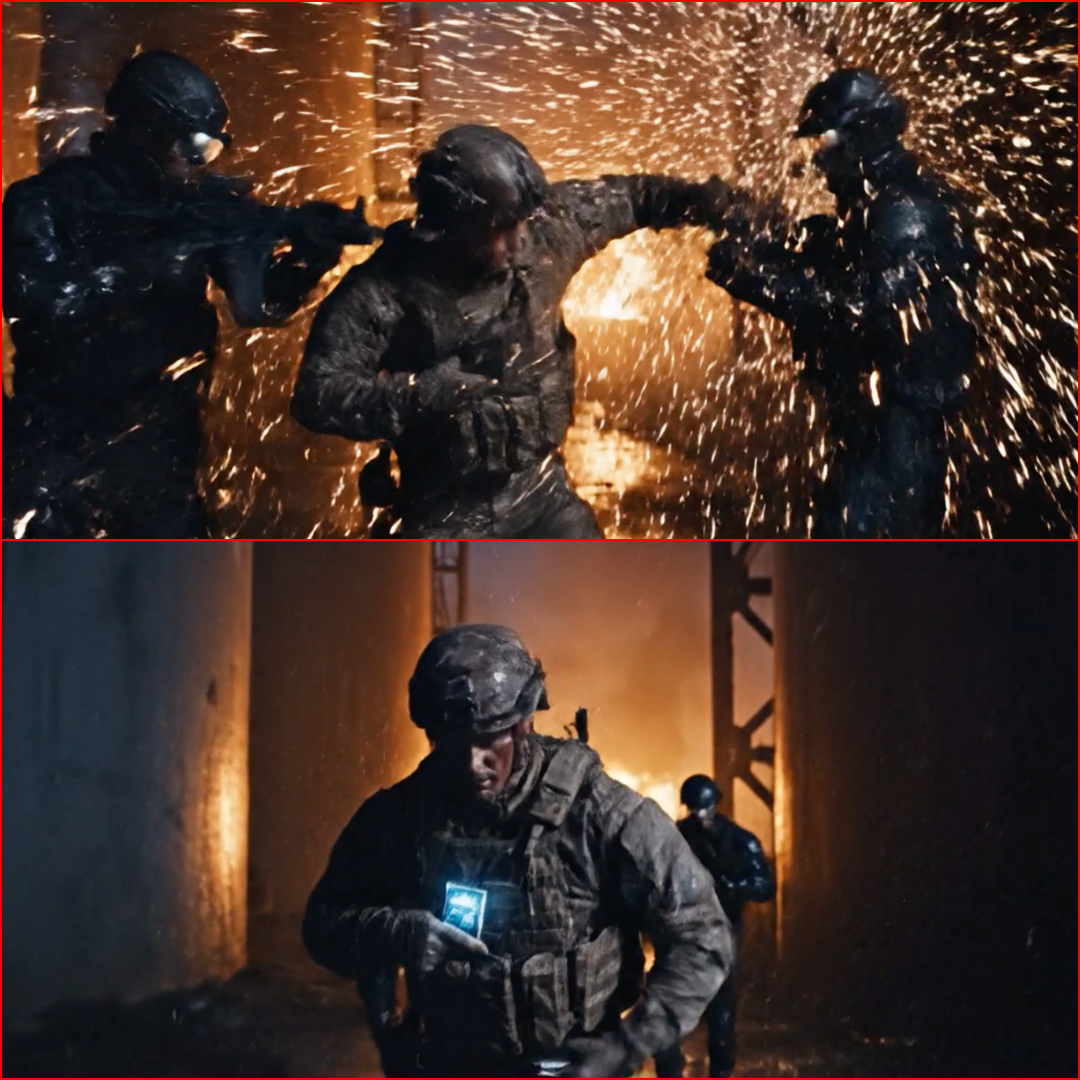
For six months, his dog tag sat in a sealed evidence bag. His personnel file was archived. His wife received a folded flag and a carefully rehearsed apology. The language was clean. The grief, not.
But the battlefield hadn’t finished with him.
Cold rain soaked through Daniel’s torn jacket as he staggered out from the ruins of a half-collapsed warehouse, boots scraping glass and ash. His beard had grown wild; his face was leaner, harder. His eyes carried something heavier than exhaustion — the look of a man who’d learned how cheaply truth could be priced.
He stopped beneath a flickering streetlamp and studied his reflection in a shattered window.
“You look like a ghost,” he muttered.
Maybe he was.
The explosion replayed in his head like a corrupted file — the flash, the pressure, the ceiling folding inward. He remembered crawling through smoke, ears ringing, lungs burning. Voices echoed in a language he barely recognized. Gunfire stitched the dark. Then nothing. Silence thick enough to drown in.
Days blurred into weeks. He survived on stolen water, scavenged food, and stubbornness sharpened by training. He avoided roads, moved by night, hid by day. When the pain peaked, he learned to make it smaller. When the fear surged, he learned to turn it into focus.
But survival wasn’t the worst part.
What haunted him was the fragment of audio he’d caught seconds before the blast — a voice cutting through static on a supposedly secure channel.
“— let them walk into it. Command has already approved the cleanup.”
Cleanup.
At first he thought it was shock. Trauma invents patterns when the mind can’t bear randomness. But the words wouldn’t leave him. They replayed with the stubborn clarity of truth.
When Daniel finally crossed into a gray-zone city that smelled of diesel and rain, he knew two things with certainty: he was alive — and someone very powerful preferred he wasn’t.
He found shelter in the back room of a shuttered mechanic’s shop. There, with shaking hands, he powered on the one thing he’d kept dry at all costs: a battered recorder salvaged from his kit. It wasn’t much — a few corrupted files, a partial timestamp — but buried in the noise was the same phrase. Same cadence. Same certainty.
Approved the cleanup.
Daniel understood the implication immediately. This wasn’t an ambush gone wrong. It was a write-off. A mission designed to disappear.
He needed proof. And he needed a way home.
Using an old burn contact, he reached Mara Voss — a former intelligence analyst turned journalist after asking one question too many. They met in a café with mirrors behind the counter and cameras that didn’t work.
“You’re supposed to be dead,” she said flatly.
“So I’ve heard.”
He slid the recorder across the table. “Listen.”
Mara’s jaw tightened as the audio crackled. She replayed it twice. Then once more, slower.
“That channel,” she said, “wasn’t tactical. It was command-level.”
“Meaning?”
“Meaning someone signed off.”
What followed was a race against a machine designed to erase friction. Daniel moved between safe houses while Mara pulled threads. Supply manifests didn’t line up. Satellite downtimes coincided too neatly. A contractor’s name appeared in three different budgets under three different aliases.
And then there was Project Blackwake.
Buried under innocuous language, Blackwake wasn’t reconnaissance. It was containment — a pretext to sanitize a transfer corridor before an unacknowledged deal. Daniel’s team hadn’t stumbled into danger. They’d been led into it.
When the first warning came, it arrived as a polite email.
Cease your inquiries. For your own safety.
The second warning wasn’t polite. A tail appeared on Daniel’s route. A door he’d locked was open when he returned. A message scratched into the dust: Stay dead.
Mara pushed to publish. Daniel hesitated — not out of fear, but precision. “Once it’s out,” he said, “there’s no walking it back.”
“That’s the point.”
They released the first piece at dawn. It didn’t name names. It didn’t speculate. It laid out timestamps, documents, and the audio. The response was immediate and furious. Officials denied everything — then amended their denials. Committees formed. A spokesperson misspoke. A contractor’s stock dipped.
And then Daniel’s face appeared on every screen.
Not as a hero.
As a problem.
A press conference announced an “ongoing review.” A senator called the story “reckless.” Anonymous sources questioned Daniel’s mental state. Trauma, they suggested, could distort memory.
Daniel watched from a darkened room, fists clenched. “They’re trying to make me the story.”
“They always do,” Mara said. “We keep going.”
The second drop included flight logs and a payment trail that ended where it shouldn’t have — a shell company tied to a private security firm with former officials on its board. The third included testimony from a drone operator who’d watched the feed go dark — not from damage, but command.
The pressure cracked something open.
A closed-door hearing leaked. A memo surfaced. The word cleanup appeared again — this time in a budget justification.
Daniel testified under oath. He spoke plainly. No speeches. No theatrics. He described the mission, the blast, the silence. He described crawling through rubble while the world moved on without him.
When they asked why he kept going, he answered without hesitation. “Because you don’t get to decide who dies for convenience.”
Outside, cameras waited. Inside, the machine recalculated.
The final twist came not from exposure, but admission.
A mid-level official broke ranks. Not out of conscience, but calculation. He confirmed the authorization. He confirmed the language. He confirmed the goal: plausible deniability.
The fallout was surgical and incomplete — resignations here, reassignments there. No one went to prison. No one used the word betrayal.
Daniel was offered a deal. Quiet compensation. A commendation amended. A future if he agreed to stop.
He declined.
Weeks later, he stood at a small memorial — not the official one, but the one that mattered. Names etched by hand. Candles burning low. He placed his dog tag on the stone and left it there.
He wasn’t a ghost anymore.
But he wasn’t done.
Because the truth, once dragged into the light, doesn’t end with a headline. It waits. It watches. And sometimes, it walks back from the battlefield — carrying a story someone approved to erase.
And this time, it refused to stay buried.