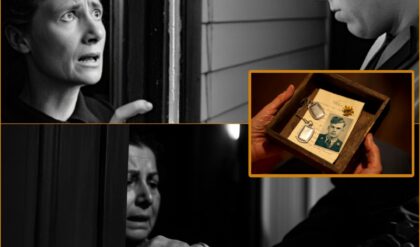
The sky was still bruised with night when the train station began to breathe.
Steam rose in pale ghosts from the iron engine, drifting into the cold spring air of 1944. Lanterns flickered along the platform like tired stars, casting trembling shadows over boots, duffel bags, and faces drawn tight with fear that no one dared to name aloud.
Somewhere in the crowd, Eleanor stood on the edge of goodbye.
Her hands were buried inside the sleeves of Thomas Hale’s army coat, as if clinging to the warmth of his body could anchor him to this world. The wool was rough against her palms. It smelled faintly of soap, metal, and the familiar comfort of home that already felt like a memory.
“Don’t let go yet,” she whispered.
Thomas smiled, but his eyes betrayed him. They were darker than usual, heavy with things he could not say — with the possibility that this moment might be the last time he would ever see her face.
“I’m not going anywhere,” he said softly. “Not yet.”
The whistle hadn’t blown. Not yet. Time still existed in this fragile pocket between heartbeats.
Eleanor pressed her forehead against his chest, listening to the steady rhythm beneath the fabric. She memorized it the way one memorizes a prayer, afraid she might need to recite it in the darkest nights ahead.
“I hate this,” she murmured. “I hate that they can just… take you.”
“They’re not taking me,” Thomas said gently. “I’m choosing to go.”
She pulled back then, eyes glistening. “Don’t pretend it’s the same.”
He sighed, brushing his thumb across her cheek. “I know. But if I don’t go, someone else will. And I need to believe this means something.”
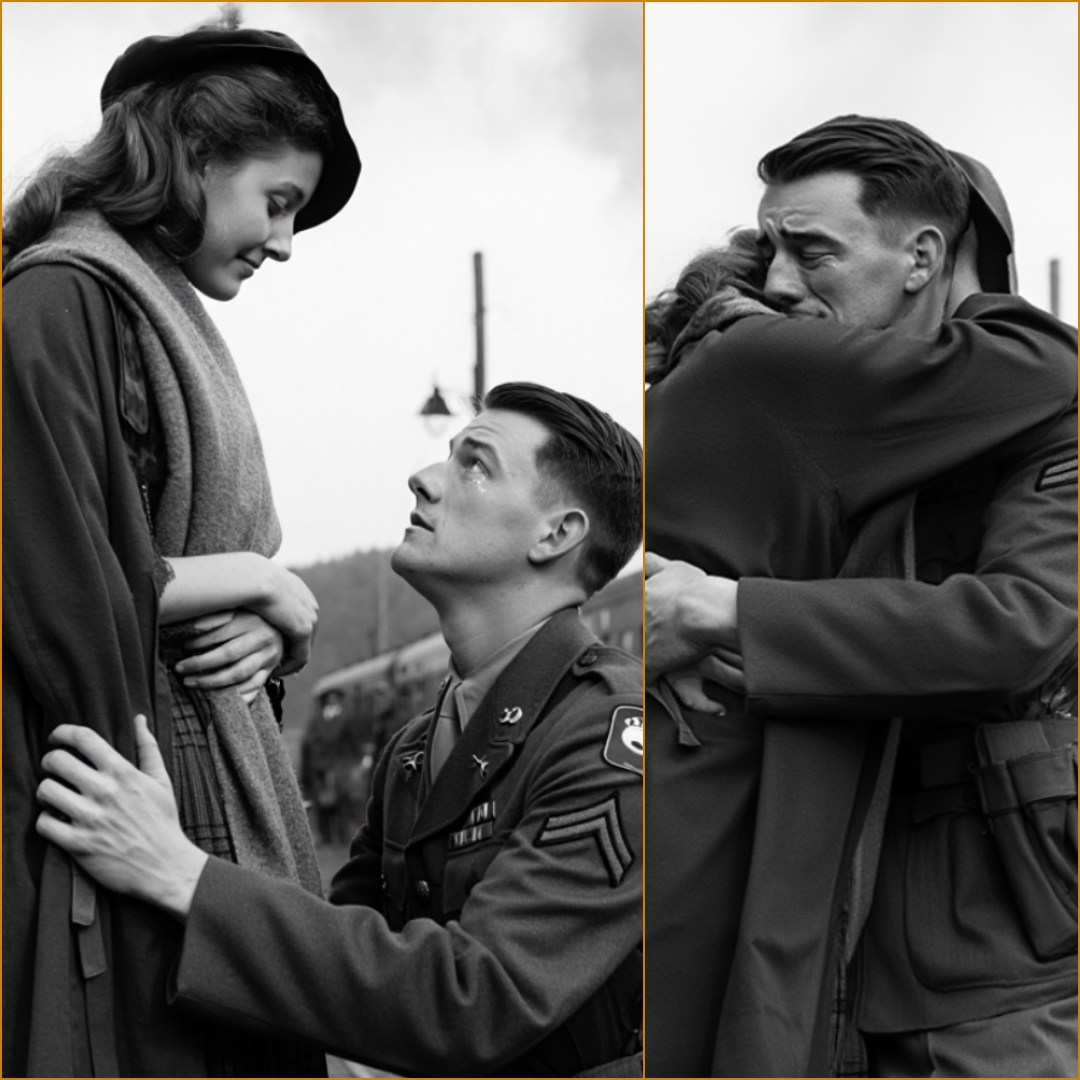
Around them, mothers clutched sons, wives held husbands, sweethearts pressed kisses into trembling smiles. Laughter burst out here and there — too loud, too forced — as if joy might trick fate into looking away.
Eleanor reached into her coat pocket and pulled out a small envelope, creased from being unfolded and refolded a dozen times.
“What’s this?” Thomas asked.
“Open it later,” she said quickly. “On the train. Or… when it gets hard.”
He nodded, slipping it into his breast pocket like a talisman.
The loudspeaker crackled overhead, announcing departures Eleanor already knew by heart. The words blurred together, swallowed by the pounding in her ears.
“Promise me something,” she said.
“Anything.”
“Promise you’ll write,” she said. “Even if you think your words are stupid. Even if it’s just one sentence.”
He smiled. “You’ve read my handwriting. That’s a brave promise.”
“Promise anyway.”
“I promise.”
She swallowed. “And promise you’ll come back.”
Thomas hesitated.
It was only a second. Only a breath. But Eleanor felt it like a knife.
“I promise I’ll try,” he said.
She nodded, accepting the honesty because she had no choice.
The whistle blew.
A long, mournful sound that cut through the station like a wound opening.
Thomas leaned down and kissed her — slow, deliberate, as if imprinting himself into her bones. Eleanor tasted salt and fear and love all at once.
“Remember the apple tree,” he whispered against her hair.
She smiled through tears. “I could never forget.”
They’d carved their initials into its trunk the summer before the war reached their town. T.H. + E.M., uneven and hopeful.
He stepped back, lifting his duffel bag. The crowd surged, bodies pressing forward.
“Thomas—” she said.
He turned.
“For whatever it’s worth,” Eleanor said, voice shaking, “loving you has already been the bravest thing I’ve ever done.”
His smile broke then — wide, real, and devastating.
He climbed aboard without looking back.
Eleanor watched until the train was swallowed by steam and distance and the sound of her own breathing.
The house felt wrong without him.
Too quiet. Too still.
Eleanor kept busy because stillness was dangerous. She took a job at the munitions factory, her hands learning the rhythm of machines and measured steps. She learned to smile at other women who carried the same fear in their eyes.
Every evening, she walked past the apple tree.
Every night, she waited for letters.
They came at first — folded paper smelling faintly of smoke and foreign air.
France is green, Thomas wrote. Greener than I imagined. Tell Mrs. Carter her pie recipe is still winning battles.
Eleanor laughed when she read that one, the sound strange in the empty kitchen.
Then the letters slowed.
Then one week passed.
Then two.
Sleep became elusive. Eleanor learned the ceiling’s cracks by heart. She counted footsteps that weren’t there. She jumped at every knock.
When a telegram finally arrived, her hands shook so badly she nearly dropped it.
Thomas Hale wounded. Condition stable.
She cried on the floor until dawn.
He wrote again weeks later, his handwriting shakier.
I’m still me, he promised. Just a little more broken.
She wrote back endlessly, filling pages with mundane details — the neighbor’s new dog, the way spring rain smelled on the dirt road — anything to tether him to a world beyond uniforms and orders.
Then silence returned.
Months passed.
Rumors replaced facts. News traveled in whispers and headlines too big to hold.
Eleanor learned how to wait without collapsing.
She pressed her ear to the radio every night. She kept the lamp burning by the window, even when the bulb flickered dangerously.
And still, nothing.
The knock came on an ordinary afternoon.
Sunlight spilled across the floor. Eleanor had been washing dishes, humming a tune she barely remembered.
Three knocks.
Her heart froze.
She wiped her hands on her apron and opened the door.
A man stood there in uniform — thinner, older, eyes haunted.
For a moment, her mind refused to accept the shape of him.
Then he smiled.
“Hi, Ellie.”
The world cracked open.
She screamed his name and slammed into him, arms wrapping tight, sobbing into his chest as if she could crawl back inside the moment before he left.
“I told you I’d try,” Thomas whispered.
She laughed and cried and hit his shoulder weakly all at once.
They stood there until neighbors gathered, until words became unnecessary.
That night, they sat beneath the apple tree.
The initials were still there, scarred but intact.
Thomas traced them gently. “Guess we survived.”
Eleanor leaned into him, head on his shoulder.
“Not all of us came back,” he said quietly.
“I know.”
They sat in silence, the kind that no longer hurt.
The war would end. The world would keep changing.
But here, beneath the tree, before another whistle could ever blow again, they were simply two people who had held on long enough to find each other once more.