The dogs didn’t whine.
They didn’t bark.
They didn’t panic beneath the thunder of rotors or the rattle of distant gunfire.
They waited.
Captain Aaron Locke stared at the tablet in his hands as if it might combust. The name on the screen felt heavier than the armored vest digging into his shoulders.
Major Ilona Varga.
KIA.
Classified.
Dead for four years.
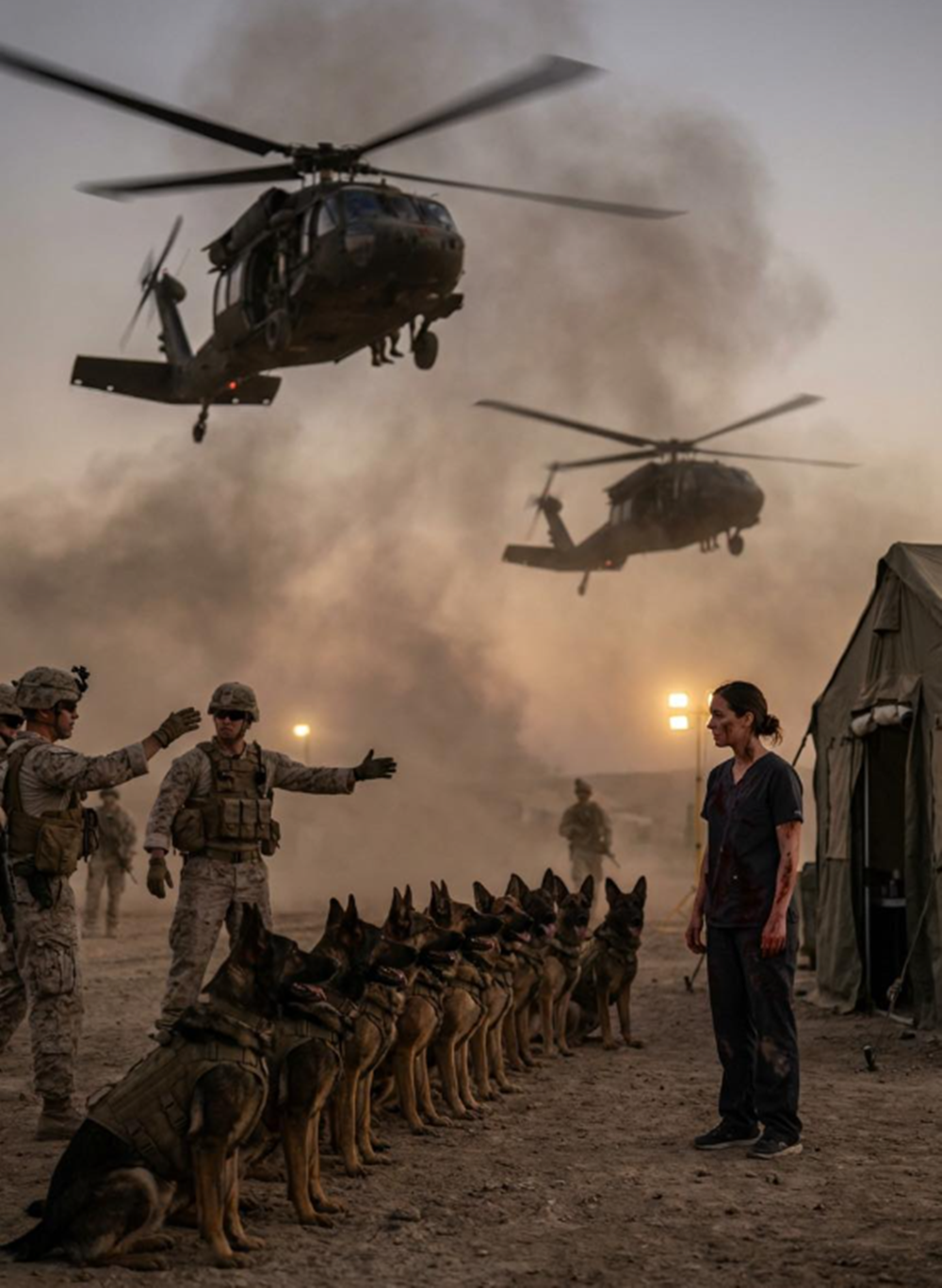
And yet she stood twenty meters away, breathing, bleeding, very much alive—while twelve of the most highly conditioned military working dogs on the continent knelt before her like soldiers recognizing their commander.
Locke looked up slowly.
“Lena Morozov,” he said aloud, testing the civilian name like a foreign language. “Or… Major Varga. Which one do you answer to?”
The woman flinched—not at the gunfire, not at the shouted commands—but at the name.
Something broke across her face. Not fear. Not confusion.
Memory.
“I don’t,” she said quietly. “Not anymore.”
The dogs remained frozen, eyes never leaving her.
The evacuation clock hit T-minus ninety seconds.
“Sir!” a pilot screamed over comms. “We’re losing fuel. We either lift or we leave people behind.”
Locke didn’t answer. His eyes were locked on the animals—and on the woman they refused to abandon.
Sentinel Handler Cell Omega hadn’t just been erased. It had been sacrificed.
Elite handlers. Experimental bonding protocols. Dogs trained not to a single voice—but to a neural pattern, stress rhythm, micro-movements of a handler’s body. It was a gamble so controversial it had nearly collapsed three allied intelligence agencies.
And Ilona Varga had been the architect.
“She trained them,” the intelligence officer whispered, as if saying it too loudly might summon ghosts. “All twelve. From imprint phase.”
Lena staggered back a step, one hand gripping a supply crate.
“No,” she said. “That’s not possible. I was a medic. I—”
A dog broke formation.
One Belgian Malinois rose smoothly and padded forward, tail low, ears relaxed. He stopped inches from her knees and gently pressed his forehead against her thigh.
The gesture was intimate. Familiar.
Lena gasped.
Her knees buckled.
Images crashed through her mind like shrapnel—snow-covered forests, night drills under blackout conditions, her own voice speaking commands in four languages, hands running over scarred muzzles, whispered apologies before missions no one was meant to survive.
“Oh God,” she breathed. “I remember.”
The dog sat.
Then the others followed.
Locke swore under his breath.
“Change of plan,” he snapped into the radio. “We’re extracting all of them.”
Silence.
Then: “Sir, that’s not—”
“Do it,” he barked. “Or we don’t leave at all.”
The handlers didn’t argue. They moved, stunned, hauling crates, clearing space, ushering dogs onto the helicopters while never quite meeting Lena’s eyes.
The dogs went willingly—but only after she stepped onto the ramp first.
Only after she turned back and raised her hand in a signal she didn’t remember learning.
The last dog boarded.
The helicopters lifted just as mortar fire tore into the edge of the landing zone.
Blackspire vanished beneath smoke and fire.
—
Three days later, in a reinforced briefing room that officially didn’t exist, Lena Morozov sat across from a panel of men and women whose uniforms bore no insignia.
A mirrored wall reflected her back at herself.
Major Ilona Varga stared from the glass.
“You were never meant to survive,” one of them said plainly.
Lena’s hands curled into fists. “I figured that out.”
They told her everything.
How Omega Cell had been deployed to expose an illegal weapons transfer masked as humanitarian aid. How the mission succeeded—and threatened to unravel a web of alliances too fragile to withstand the truth.
How the decision was made.
Scuttle the unit.
Declare them dead.
Bury the evidence.
Ilona Varga had been critically wounded during extraction. A medic—another medic—had swapped her ID tags in the chaos. She was evacuated under civilian cover with a wiped identity and instructions that amounted to exile.
The memory loss hadn’t been an accident.
It had been mercy.
Or punishment.
“And the dogs?” Lena asked.
“They were reassigned,” the official said. “Or supposed to be.”
Locke stood at the back of the room, arms crossed. “They never bonded again.”
Silence followed.
“They failed every reassignment,” he continued. “Wouldn’t respond. Wouldn’t deploy. We thought the program had broken them.”
Lena closed her eyes.
“No,” she said softly. “You broke us.”
Outside the room, twelve dogs lay in a quiet corridor, heads resting on their paws, ears flicking toward her heartbeat through concrete and steel.
They had waited four years.
They would have waited longer.
—
The official report listed the Blackspire incident as a behavioral anomaly.
No mention of Sentinel Omega.
No correction to the KIA status.
No acknowledgment that twelve war dogs had just disobeyed direct orders to save the woman who taught them how to survive.
But some things don’t stay buried.
Handlers started talking.
Footage leaked—grainy, silent video of twelve dogs kneeling in unison beneath helicopter blades.
Veterans recognized the posture immediately.
Recognition.
Loyalty.
Home.
Lena Morozov disappeared two weeks later.
So did the dogs.
Officially, they were retired.
Unofficially?
In a quiet compound far from borders and politics, a woman walks at dawn with twelve shadows pacing perfectly at her side.
She doesn’t wear a uniform.
She doesn’t give commands.
She doesn’t need to.
They know who she is.
And if the world ever needs them again—
They’ll be ready.
Together.