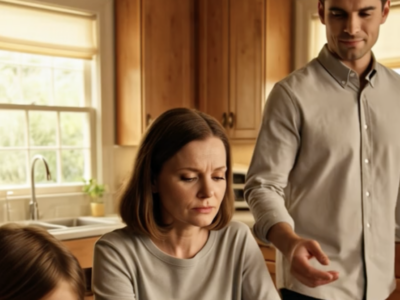
If you’re reading this in your thirties, forties, fifties, and something in your body hums out of tune—don’t gulp the smoothie because love mixed it. Ask a friend with a degree. Lock a door. Save a file. You’re not crazy for preferring a truth that hurts over a lie that lets you sleep.
David had always made breakfast—eggs, toast, the juice in the tall IKEA glasses. Lately the juice tasted faintly wrong: not spoiled, but off, as if a vitamin had been crushed into it. When I mentioned it, he laughed. “New brand. More pulp. Drink up.”
I did. Because nineteen years trains you to drink what you’re handed.
Our daughter, Emma—sixteen, sharp, quiet—said something one March evening that I couldn’t unknot. We were doing dishes; David had taken our son, Ethan, to basketball. The window above the sink showed our reflection layered over the backyard.
“Mom,” Emma said, not looking at me, “do you ever sleepwalk?”
“I don’t think so. Why?”
She dried a plate slowly. “Sometimes I get up for water. Your door’s open. You’re just… still. And Dad’s in there. The light’s on in the closet.”
My hands kept moving in the suds, but something cold threaded my ribs. “Maybe I was sick. Maybe Dad was checking on me.”
“Yeah. That’s probably it.”
She never brought it up again. I told myself she was a teenager inventing dramas. I told myself the closet light was the motion sensor we’d installed.
That night I poured my own water. I did not drink anything David made. I lay awake until one-thirty, listening to the house breathe—furnace click, fridge hum, Biscuit’s nails on the hardwood.
Nothing happened.
Relief made me feel ridiculous.
Three nights later I took a swallow from his smoothie “for your vitamins” and woke with sand in my head and a soreness low and intimate that wasn’t menstrual, wasn’t familiar. I stood in the shower until the water ran cold, watching pink spiral down the drain, and thought: When did I last say yes to this? When did I last say no?
I couldn’t answer.
The warning signs weren’t thunderclaps. They were whispers: bruises, lost hours, juice that tasted like cover stories. Nineteen years of trust is a fortress until one night you hear scratching at the gate—not a stranger’s hand, but your husband’s key in the lock.
I decided, watching David whistle through Saturday yard work, that I needed proof before I burned my life down. Proof, because without it, I’d only be a tired woman accusing the man everyone loved.
I didn’t yet know he’d been documenting proof for years.
Part II: What the Night Kept
The first thing I did was call my college roommate, not the police.
Nina lives in Eugene, practices family medicine, has seen every kind of harm people do to people they claim to love. I whispered in my car in the hospital garage, engine off, February rain ticking the roof.
“Hypothetically,” I said. “What sedatives show up in urine if someone’s being dosed at home?”
Long pause. “A lot of them. Depends what’s used. Why hypothetically?”
I told her about the gaps, the taste, the bruises. I didn’t tell her about the soreness—I couldn’t say it aloud. She didn’t interrogate. She said, “Don’t drink anything he gives you. Tomorrow first void—bring it in. I’ll run a tox screen off the books. Sarah—is your bedroom door locking from the inside?”
It wasn’t. We’d never needed it to.
“Get a lock. Or wedge a chair. Tonight.”
David that night mixed chamomile “because you’re stressed.” I poured it down the sink when he walked the dog. I slept in leggings and a sports bra, door wedged with a dining chair back, phone recording audio under the pillow—ridiculous, paranoid—and still slid under in the small hours as if pulled by a undertow.
I didn’t wake when the recording later showed the chair scraping.
In the morning Nina’s text was two words: Call me.
At work, in a supply closet, she read results like a biopsy. “Mid-range benzodiazepine metabolites. Not a prescribing dose for you. Someone’s been giving you something, probably repeatedly.”
The floor tilted. I gripped steel shelving. “It couldn’t be an accident?”
“In juice? On a schedule? Sarah.”
I took FMLA leave for two weeks “for stress.” David fussed—brought flowers, suggested a lake weekend to reset. I smiled and packed a go-bag into my trunk, one item at a time so he wouldn’t notice.
While he was at a site visit in Tacoma, I changed.
I bought a cheap Wi-Fi motion camera disguised as a phone charger, synced to a cloud account he didn’t know. I put it on the dresser. I told myself I was insane. I told myself if nothing showed, I’d apologize and book couples therapy and never doubt him again.
Two mornings later the notification pulsed at 2:48 a.m.
The live clip buffered, then played: me on the bed, limbs loose, eyes open but gone. David’s silhouette. Closet door open. A red light winking inside—camera on record.
My body. My bed. My husband. And I was not there.
I vomited in the guest bathroom, shaking so hard my molars ached. When I could stand, I called Nina again. She said, “Do not confront him. Do you have somewhere safe?”
I did now.
The next forty-eight hours were a blur of legal aid, a women’s shelter intake on the phone, copies of the clip to an encrypted drive. A detective specializing in domestic crimes—Detective Reyes—met me at Nina’s office. Calm voice, no judgment. “We’ll need more than one clip. We’ll need devices. If you’re willing, when you leave, don’t announce it. Go.”
“I can’t leave the kids.”
“Bring them when it’s safe. Tonight he’s on the night shift?”
“He says he is.”
He wasn’t. The clip had him home.
Thursday afternoon Ethan had practice; Emma was at a friend’s. I told David I was running errands. Instead I walked into a locksmith, added a keyed deadbolt to our bedroom—outwardly innocent “for safety while I’m alone on nights.” He smiled. “Smart idea.”
That night I didn’t wedge the chair. I didn’t sleep. At 1:10 a.m. the charger-cam chirped.
On my phone, David crossed the frame carrying a glass of water. He set it on the nightstand. He spoke low—not to wake me, but because he’d done this before. Routine. Habit. Ritual.
I watched myself drink on autopilot. Watched my head fall back. Watched him lean close and say something the mic almost caught—my name, maybe, or a word that wasn’t love.
I turned the clip off before the next frame. I didn’t need to see what I couldn’t unknow.
At dawn I moved: kids to Nina’s, bags already there. Email to Reyes: I’m ready. Devices are in the house. He leaves for work at 7:30.
They executed the search warrant at 9:15 on a Friday. I wasn’t there. Emma cried at a friend’s; Ethan didn’t know yet. Reyes called me at noon.
“Ms. Morrison—we need you to come in. Alone first. Bring your lawyer if you have one.”
They’d found three hidden cameras. A locked folder tree on his laptop. External drives in the crawlspace, labeled by month and year.
I asked only one question: “Am I on them?”
Reyes looked at her notebook, not my eyes. “Yes. We believe you were incapacitated. We believe there are multiple files. It’s going to be okay. You did the hardest part. You stopped not knowing.”
David Morrison was arrested at his office. The man who brought orange juice. The man who volunteered for carpool. The perfect family man.
The neighborhood group chat exploded before I’d read a single caption.
Part III: The Body’s Testimony
People want a villain with fangs. David had competent hands and a calendar app. That’s the horror—they sit next to you in church, sign your birthday cards, fix your mother’s gutter.
The trial was fourteen months later—COVID backlog, continuances, his attorney chipping at “marital privacy” until the judge shut it down. I testified with the fragmented dignity they teach you in survivor advocates’ prep: times, symptoms, tox screens, clips I was shown in a closed room—not in open court. I did not describe what was on the drives. I said, “I was not conscious. I did not consent. I was filmed without knowledge while incapacitated.”
Emma sat in the hall with Nina; Ethan, seventeen by then, chose not to attend. David pleaded to reduced charges in a deal that still put him away for twelve years. His mother sent a card calling me a destroyer of families. I pinned it above my desk—a reminder that some people mourn the mask, not the victim behind it.
Recovery isn’t a montage. It’s Tuesday.
Therapy twice a month. A support group where women our age—forties, fifties—compare notes on sleep, trust, whether to date again. I went back to ICU part-time; the chaos there almost comforts me. Emma and I share a rental now—double deadbolts, a dog she walks at dusk. Ethan started college in-state; he calls less than I’d like, more than I deserve.
Some nights I still wake at 4:12, throat dry. I check the lock, the chain, the silence. My body keeps score even when my mind wants amnesty.
At group last week, a woman named Diane asked how I “knew it was real and not perimenopause.” I said, “I didn’t want it to be real. My body knew first. Bruises, hours gone, juice that tasted like lies. The mind catches up when it can’t protect the story anymore.”
We’re not detectives in our own marriages. We’re not required to be. But we’re allowed to listen when flesh and bone vote differently from loyalty.
I don’t use his last name in public now. The kids can choose theirs when they’re grown. I cook my own breakfast. I buy juice no one else has touched.
Last Sunday Emma and I drove the coast. She asked, quiet, “Do you hate him?”
“No,” I said—truth, not virtue. “I hate what he did. Hating him would keep me in his bedroom at 2:48 a.m. I’m not going back there in any sense.”
She nodded. “I saw the clip title on the news feed. I didn’t open it.”
“Thank you for that.”
“I believe you, Mom.”
Four words every survivor’s nervous system waits decades to hear.
The story that still gets clicks—the perfect family man, the depravity behind the cul-de-sac—isn’t exotic. It’s proximity. Warning signs without a neon label. Trust weaponized into access.
If you’re reading this in your thirties, forties, fifties, and something in your body hums out of tune—don’t gulp the smoothie because love mixed it. Ask a friend with a degree. Lock a door. Save a file. You’re not crazy for preferring a truth that hurts over a lie that lets you sleep.
I sleep better now. Not because the house is innocent. Because I am the one who decides what crosses my threshold, glass in hand, eyes open.
The man who brought me orange juice won’t hand me anything again.
And I have learned, finally, to trust the woman who woke with bruises she never earned, and hours she never lived—my body, keeping watch when I could not.