Unsent Secrets, Midnight Scandals, and the Billionaire Museum Owner Who Called My Bluff at Ten O’Clock on a Saturday
Unsent Secrets, Midnight Scandals, and the Billionaire Museum Owner Who Called My Bluff at Ten O’Clock on a Saturday
Part 1: The Glass Office on Michigan Avenue
The rain on Saturday morning smeared the glass along Michigan Avenue into long, grey streaks. Mara stood inside the administrative entrance of the Centennial Museum, her fingers wrapped tightly around a thick black leather portfolio. Her knuckles were white.
“Miss Ellis?” the security guard asked, glancing up from a polished mahogany desk. He didn’t check a printed sign-in sheet. He clicked a button on a brushed-aluminum console. “Mr. Hale is waiting for you on three.”
The private elevator moved without a sound. Mara watched the illuminated numbers tick slowly upward—1, 2, 3—and tried to slow the frantic rhythm of her heart. Twelve hours ago, she was an exhausted exhibition coordinator nursing a cold cup of tea, burning her toast, and preparing to walk away from four years of stolen credit and silenced ambition. Now, she was ascending to the sanctum of the man whose name was etched in gold leaf across the building’s facade.
When the brass doors slid open, Mara stepped onto hand-knotted Persian rugs that muffled her footsteps completely.
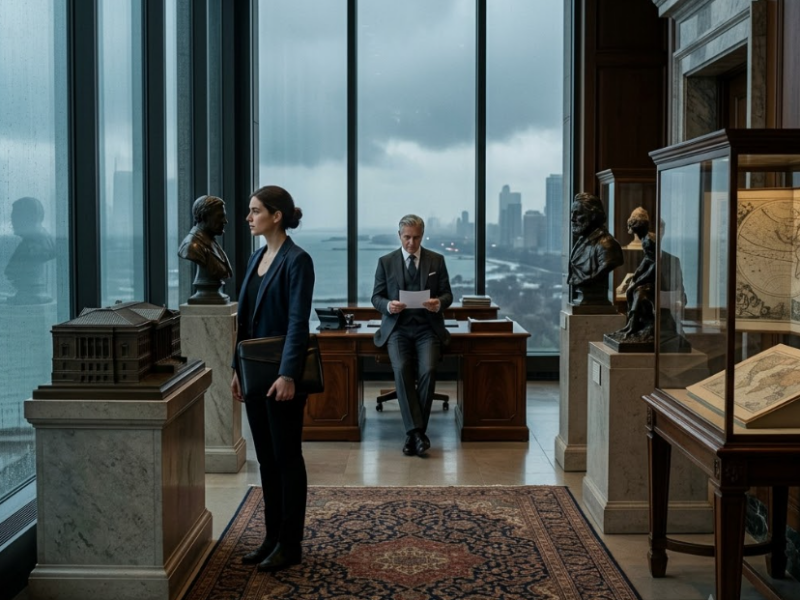
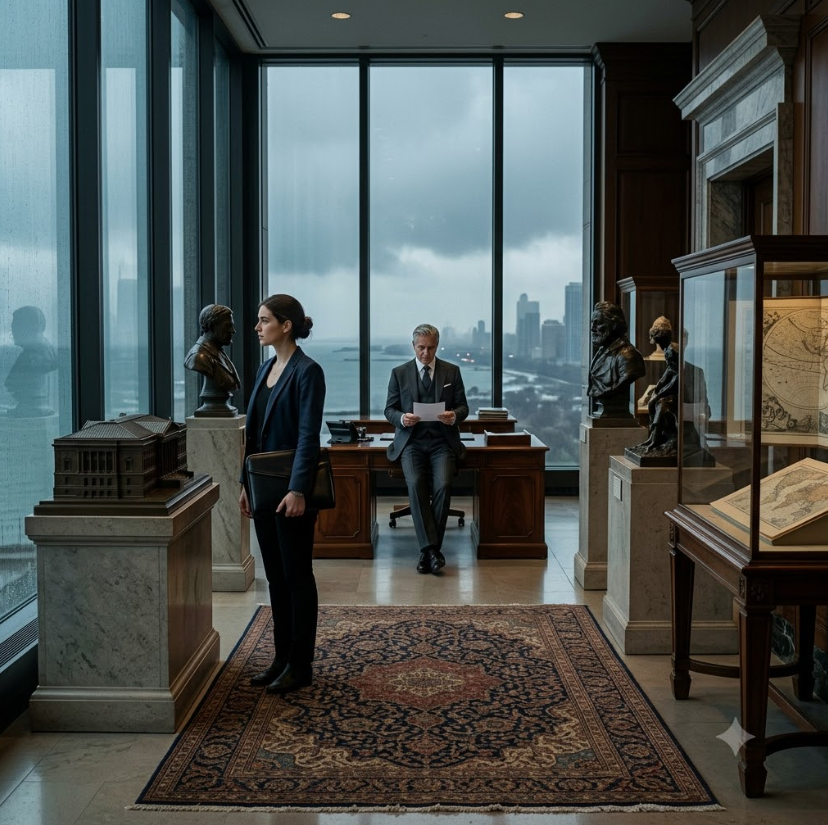
The top floor was not an office; it was a sanctuary of art and architecture. Floor-to-ceiling windows looked out over Lake Michigan, which churning under the grey sky. Surrounding the room were priceless artifacts—19th-century bronze sculptures, rare maps framed in ironwood, and framed blueprints of the museum’s original 1893 construction.
At the far end sat Edward Hale.
He looked precisely as he did in business journals, yet vastly more intimidating in person. Crisp navy suit, silvering dark hair, precise posture. He wasn’t looking at a computer screen. He was holding a printed piece of paper—her resignation email—and reading it with the intensity of a scholar examining an ancient manuscript.
“You’re three minutes early, Miss Ellis,” Edward said, his deep voice carrying effortlessly across the vast room. He did not look up immediately. He finished reading, placed the paper down on his desk, and smoothed it flat with the palm of his hand.
“I didn’t want to keep you waiting, Mr. Hale,” Mara said, stepping forward. Her voice remained steady, despite the nervous tremor in her legs.
Edward rose from his chair and indicated a leather armchair across from his desk. “Sit.”
Mara sat, resting her portfolio across her knees like a shield.
“I reread your email four times last night,” Edward began, resting his forearms on the desk. “It was quite a document. Half formal notice, half forensic breakdown of departmental corruption. You claimed that seventy percent of the Centennial’s summer curatorial lineup was copied directly from your internal pitches over the last eighteen months.”
“It was,” Mara said quietly. “And I have the dated file backups to prove it.”
Edward leaned back, studying her face. “Peter Maddox submitted those concepts as his own. His quarterly reports claimed he designed the layout for the gilded-age textile exhibit himself.”
“Peter Maddox hasn’t stepped foot in the textile archive since 2022,” Mara countered, a spark of indignation overriding her anxiety. “He took my white paper, removed my cover page, and placed his signature on the header. I brought it to HR six months ago. I was told that senior management reserves the right to compile team research under departmental leadership.”
“HR answered to Peter,” Edward said calmly. “And Peter answered to a board that preferred smooth operations over uncomfortable truths.” He tapped his fingers against the desk. “Open your portfolio, Miss Ellis. Show me what else he took.”
Part 2: The Stolen Archives
For the next forty-five minutes, the billionaire owner of the museum network did not act like an intimidating executive. He acted like an archivist.
Mara spread her blueprints, layout diagrams, and research summaries across Edward’s desk. She walked him through her proposal for America at the Turn of the Century, demonstrating how she had sourced forgotten photographs from working-class neighborhoods, mapped out interactive lighting grids, and designed a floor plan that guided visitors through the brutal reality behind the Gilded Age’s glittering exterior.
Edward listened without interrupting. He examined her handwritten margin notes. He traced the lines of her structural sketches with a gold fountain pen.
“This isn’t just an exhibit,” Edward said softly, turning a page containing a draft for an interactive industrial display. “This is an argument. You’re telling a story that most institutions are too coward to show.”
“Museums shouldn’t be mausoleums for rich men’s collections,” Mara said, before she could filter herself. She stopped, biting her lip. “I apologize. That was blunt.”
A subtle, dangerous smile touched the corner of Edward’s mouth. “Don’t apologize for having a spine, Miss Ellis. It’s the first interesting thing I’ve seen in this building all year.”
He pulled a thick blue folder from his side drawer—her official employee file—and flipped it open.
“Peter Maddox filed a counter-memo at eight o’clock this morning,” Edward said, his tone turning cold as ice. “It appears he noticed you sent your resignation to the wrong address. He sent an urgent request to lock your access badges and archive your digital drives, claiming you were attempting to steal proprietary museum research on your way out.”
Mara felt the air leave her lungs. “He’s lying. Those are my original research notes!”
“I know he’s lying,” Edward said simply. He stood up and walked toward the tall glass windows, looking out at the rain. “Peter is efficient at two things: taking credit for other people’s labor, and panicking when his power is challenged. He didn’t realize that every draft you submitted to the museum network was automatically timestamped on our secure cloud server—a server that answers directly to my family’s foundation, not his office.”
Edward turned back to face her, his silhouette framed against the stormy sky.
“At nine thirty this morning, I initiated an emergency audit of Peter Maddox’s entire department,” Edward revealed. “Security is currently escorting him out of his office. His hard drives are being impounded, and his contract is being terminated for gross professional misconduct.”
Mara sat frozen in her chair. “You… you fired him?”
“I fired a fraud,” Edward corrected, walking back to his desk. “Which leaves us with an empty corner office on the second floor, a major autumn exhibition with no lead curator, and an institution that desperately needs someone who actually cares about the truth.”
Part 3: The New Curator
Mara looked at the empty leather chair across from her, then back to Edward Hale. The sheer speed of the morning was dizzying. Less than fourteen hours ago, she was contemplating updating her resume for entry-level jobs at small suburban historical societies.
“You’re offering me Peter’s job?” Mara asked, her voice hushed.
“I’m offering you the Senior Curatorial Directorship of the Centennial Museum,” Edward said, resting his hand on her binder. “With a budget three times larger than what Peter gave you, complete artistic autonomy over the autumn season, and a direct line to my office. No middle management. No stolen credit.”
“Why?” Mara asked directly. “You don’t know me, Mr. Hale. You’ve seen me twice in four years.”
“I know your work,” Edward replied. “I’ve walked through your children’s discovery wing on Sunday afternoons when the museum was off-limits to donors. I saw how you restored the 1880s printing press using original parts instead of modern replicas. You care about the integrity of the history we house here. Peter cared about his title.”
He pulled a fresh document from his desk—a formal contract, pre-printed with her name at the top—and placed it alongside a heavy brass pen.
“However,” Edward added, his gaze holding hers with quiet intensity, “there is one condition.”
Mara narrowed her eyes slightly. “What condition?”
“You never send another resignation letter to the wrong email address,” Edward said, a faint, rare spark of humor lighting his eyes. “If you ever decide to leave this institution, you will hand it to me in person, over a cup of coffee, and tell me to my face where I went wrong.”
Mara looked down at the contract. The salary listed was double what she had been earning under Peter. The resources allocated to her America at the Turn of the Century project were unlimited.
She picked up the brass pen. The weight of it felt solid, real, and heavy in her hand.
“I can agree to those terms, Mr. Hale,” Mara said.
She signed her name across the bottom line with a smooth, unwavering stroke. When she set the pen down, Edward extended his hand across the desk. Mara took it, feeling the firm, decisive grip of a man who didn’t make mistakes—and didn’t waste time on regret.
“Welcome to the top floor, Director Ellis,” Edward said softly. “Now, let’s go build your museum.”