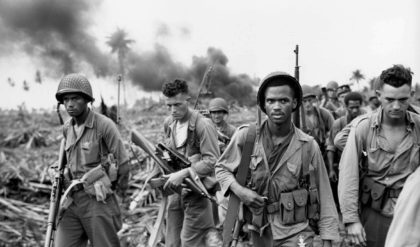
Hogan’s 400: The Christmas Eve Walk Through Hell
Ardennes, Belgium – 24 December 1944, 2200 hours
The wind came down from the north like a bayonet, slicing through wool and flesh alike. Snow fell in hard, dry crystals that stung the eyes and froze on eyelashes. The temperature had dropped to minus twenty Celsius; the coldest winter the Ardennes had seen in a century.
In the ruined crossroads hamlet of La Gleize, four hundred American soldiers stood in a silent semicircle around their burning tanks. The Sherman “Thunderbolts” of the 3rd Battalion, 33rd Armored Regiment, Third Armored Division, “Spearhead”, had run dry. No fuel. No 76 mm shells. Only a handful of .30-caliber rounds and the clothes on their backs.
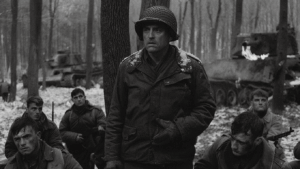
Lieutenant Colonel Samuel Hogan, twenty-eight years old, West Point ’38, a lanky Texan with a voice like gravel and eyes that had seen Paris liberated and the Rhine crossed, looked at his men. They were blackened with soot, frostbitten, half-starved. Some had lost fingers to the cold. All had lost friends.
Hogan spoke quietly, so only the nearest could hear over the crackle of burning gasoline.
“Boys, we’ve done our job. We held the line. Now we’re going home for Christmas.”
A ripple of tired laughter. Home was thirty kilometres behind German lines.
They began the ritual of destruction.
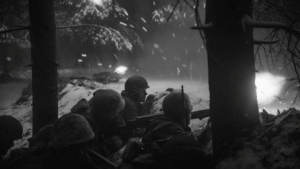
Radiomen smashed their SCR-300 sets with rifle butts. Crews poured the last cans of sugar into fuel tanks, then tossed thermite grenades into turrets. The Shermans belched orange fire, lighting the snow like hellish birthday candles. One by one, the steel beasts that had carried them from Normandy to the Siegfried Line died in flames.
Hogan gave the order.
“Single file. No talking. No smoking. If we meet Jerry, we ghost through. If we can’t ghost, we fight quiet.”
Four hundred men formed a snake of shadow. Blackened faces, rifles slung, knives ready. They left the burning village behind and stepped into the forest.
The first mile was the worst. The snow was knee-deep, the pines so thick that moonlight barely reached the ground. Every branch dumped a load of ice down their necks. Boots crunched too loud; men learned to walk on the sides of their feet like Indians. Breath froze in moustaches. Frostbite began its silent work.
Hogan walked at the front with his runner, Corporal Eddie Ricks, a nineteen-year-old kid from Baton Rouge who still carried a rosary in his pocket. Behind them came the walking wounded, then the machine-gun teams with their tripods slung like rifles, then the rest.
They moved west by compass and instinct, following frozen streams when they could, avoiding roads where Panzers prowled. At 0200 on Christmas morning they crossed a logging trail and found fresh Tiger tracks. Hogan knelt, touched the tread marks still steaming in the snow. The tank had passed less than an hour ago.
He looked back at his column: four hundred ghosts in white camouflage, eyes hollow, lips blue.
“Keep moving,” he whispered.
At 0400 they heard voices: German. A patrol, maybe twenty men, warming themselves around a fire beside a knocked-out half-track. The Americans dropped flat. Hogan signalled: crawl.
Four hundred men inched forward on bellies through the snow, rifles dragging, hearts hammering so loud they feared the Germans would hear. The firelight flickered on SS runes. A machine-gun nest covered the trail.
Hogan made the decision. They would go around, through a ravine so steep it was nearly a cliff. One by one they lowered themselves, fingers bleeding on icy rock, boots slipping. A BAR man lost his footing and slid twenty feet, biting his glove to keep from crying out. They caught him, hauled him up, kept moving.
Dawn found them on the far side, still alive, still together.
By noon on Christmas Day they reached the Ourthe River, swollen with meltwater and ice floes. On the far bank, American lines. Between them and safety: a blown bridge and a German rear-guard company dug in with MG42s.
Hogan gathered his officers – what was left of them – behind a fallen log.
“We cross here or we die here,” he said simply.
They crossed at dusk, using ropes fashioned from signal wire and belts. The first men made it, then laid down covering fire as the rest waded chest-deep through water that felt like liquid fire. The Germans woke up late. Tracers stitched the river. Men fell. Others kept moving.
When the last man reached the far bank, only 312 remained.
But they were home.
American artillery opened up behind them, shells screaming overhead toward the Germans. GIs from the 82nd Airborne ran forward with blankets and hot coffee. Someone started singing “Silent Night.” Others joined in, voices cracking.
Hogan stood on the bank, soaked, frostbitten, tears freezing on his cheeks. A young paratrooper offered him a cigarette.
“Merry Christmas, Colonel.”
Hogan took the smoke with shaking fingers.
“Best damn Christmas I ever had.”
History remembers them simply as Hogan’s 400.
The men who walked out of hell on Christmas Eve, 1944, carrying nothing but their lives and the memory of the friends they left behind.