Prologue: Sky of Iron, Sky of Fate
The English Channel shimmered like a sheet of molten silver as the sun rose behind Dunkirk. It was June 1, 1940—a day that had already begun writing itself into the long, blood‑marked ledger of war. At 7:45 AM, slicing through a haze so thin it seemed painted onto the air, came the harsh snarl of a Rolls‑Royce Merlin engine. A Hawker Hurricane burst through the mist, its wings trembling with the ferocious heartbeat of a machine built for survival.

Inside sat Squadron Leader Douglas Bader, a man who by all conventional logic had no business being in a fighter cockpit. His hands gripped the stick with the steady familiarity of someone born to fly. His jaw was set, his eyes narrowed—a predator scanning for movement.
Up ahead, a dark speck formed on the pale horizon. It grew into the unmistakeable outline of a Messerschmitt Bf 109, the vanguard of German air superiority. It flew straight, unaware of the British fighter stalking silently from behind.
Three hundred yards. Two hundred fifty miles per hour. Four Brownings ready.
A perfect opportunity.
Except, of course, for the part where the man about to pull the trigger had no legs.
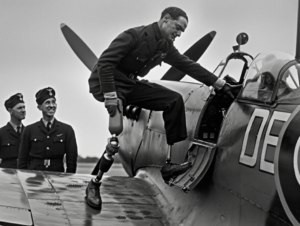
Where other pilots had muscle and bone, Douglas Bader had two prosthetic limbs—metal, leather, and fierce determination strapped to the stumps of his thighs. Nine years earlier, the RAF had declared him medically unfit to fly, maybe even unfit to live. Yet here he was, rising above one of the darkest moments of British history.
He pressed the firing button.
Tracers carved burning paths through the sky. The Messerschmitt buckled, its canopy exploding. Smoke trailed behind the dying machine as it spiraled downward.
One kill. The first of many.
This is the story of how a man the Germans first mocked—“der beinlose Pilot”, the legless pilot—became one of their most formidable enemies. It is a story told not merely with facts, but with the beating heart of cinema, the weight of history, the reflection of human struggle, and the thunder of myth.
Chapter 1: A Boy with Too Much Sky in Him
Douglas Robert Steuart Bader entered the world in 1910 with a force that suggested even then he might not remain tethered to earth. From childhood he was restless, energetic, bold to the point of recklessness. He raced other boys without thinking, climbed where he shouldn’t, and seemed forever in motion. Teachers complained he lacked discipline; friends claimed he lacked fear.
At thirteen he discovered airplanes.
The first time he watched a biplane rise from a field, wings shimmering under the sun, something irreversible clicked into place. It wasn’t admiration. It wasn’t curiosity. It was recognition—an instinctual certainty that he belonged up there.
When he joined the RAF College at Cranwell, instructors noted his confidence, his exceptional reflexes, his sharp mind. They also noted his arrogance. Bader did not simply enjoy competition; he inhaled it. If someone flew well, he flew better. If someone challenged him, he met the challenge with a grin sharp enough to cut.
By 1930 he was a commissioned officer, a rising star. His flying was graceful, daring, instinctive. He made the sky his theatre.
But theatre invites risk.
And risk sometimes collects its due.
Chapter 2: The Day the Sky Took Him
December 14, 1931. Wethersfield Aerodrome. A cold, brittle day.
Bader was practicing low‑level aerobatics—maneuvers so dangerous regulations technically forbade them. But rules had never been something he considered binding unless they suited him. He dipped low, pulled hard, rolled into a maneuver he considered challenging but manageable.
He miscalculated.
The wingtip clipped the ground.
Metal screamed. Fuel spilled. The world cartwheeled. A roar, a burst of fire, then darkness.
When he regained consciousness, he tasted blood and smoke. His legs were ruined beyond repair.
In the hospital the prognosis came cold and clinical:
both legs amputated. One above the knee. One below.
He drifted in and out of delirium as surgeons sawed and stitched. He felt the emptiness beneath the sheets. He felt the sudden, crushing collapse of identity.
The RAF medical board issued its judgment with bureaucratic calm:
“Permanently unfit for flying duties.”
His career was over. His dreams were over. His life felt over.
But Douglas Bader was not a man who accepted endings he had not chosen.
Chapter 3: Rebuilding the Unbuildable
Recovery was a war. Not the clean kind where uniforms and medals gave suffering a veneer of dignity. This was raw, deeply human combat.
The prosthetic legs crafted for him were primitive, heavy, stiff. They chafed until sores bled. They refused to move where he wanted. Walking felt like dragging anchors. Standing felt like punishment.
But he trained.
Hour after hour, day after day.
He forced the prosthetics to obey him through repetition and fury. He strengthened the muscles of his hips and back until he could run, climb stairs, and even dance. He relearned how to live—and then set his sights on the goal everyone agreed was impossible.
He learned to fly again.
He convinced a flight instructor to let him try, and once he strapped in, his spirit reawakened. He took off, and the moment the wheels lifted from the ground, he remembered everything.
Flying relied on hands, eyes, instinct. Not legs.
He landed the aircraft as smoothly as any pilot with fully intact limbs.
But the RAF refused to reinstate him.
Rules were rules.
Defeated but not broken, he left the service. He worked in civilian life, kept fit, kept sharp, kept annoyed.
Then war began.
And the RAF discovered it needed every pilot it could get—even the impossible ones.
Chapter 4: Return of the Iron‑Willed Pilot
Bader passed his medical review with stunning precision. He demonstrated takeoffs, landings, emergency drills—all with flawless execution. The examiner questioned whether the prosthetics affected endurance.
Bader gave one of the most iconic replies in RAF history:
“My legs don’t get tired.”
Reinstated as a flight lieutenant, he joined No. 19 Squadron. His first months were a turbulent mix of exhilaration and mishap—once even crashing a Spitfire due to misreading the unfamiliar controls. But instead of dampening his confidence, the experience only sharpened his resolve.
When he eventually took command of No. 242 Squadron, composed mainly of Canadian pilots exhausted and demoralized from early defeats, the unit was on the verge of collapse.
Then the man with metal legs strode in.
He drilled them relentlessly, demanded discipline, and rebuilt their pride not by coaxing but by embodying defiance.
The men followed him because he led from the front—with ferocity, precision, and a refusal to accept defeat.
And then, on the morning of June 1, 1940, he scored his first confirmed kill.
The legend had begun.
Chapter 5: The Battle That Forged Legends
As the Battle of Britain ignited, the RAF found itself standing alone against the full force of the Luftwaffe. The sky over England became a brutal arena. Smoke trails twisted like serpents. Engines roared like titans. Death came at 20,000 feet with no warning but a flicker of shadow.
Bader was in his element.
He flew with an aggression that bordered on reckless but was always calculated. He believed in getting close to the enemy—dangerously close. Close enough that even poor aim couldn’t miss. Close enough that hesitation meant death.
He fought not just aircraft but strategy itself. He spearheaded support for the Big Wing—the idea that multiple squadrons massed together would hit harder than isolated units. Military leaders debated it endlessly, but Bader was uninterested in debate. He wanted action.
His kill count climbed.
One by one, German fighters fell under his guns. He saved wingmen. He rallied squadrons. He led formations with the confidence of a man who saw the sky not as a threat but as a kingdom.
By the end of 1940, Bader was a national hero—a symbol of British resilience.
But even heroes bleed.
Chapter 6: The Sky Takes Him Again
August 9, 1941. Northern France.
A chaotic dogfight spiraled across the clouds. Bader’s Spitfire—D‑B, his personal mount—collided with another aircraft in the melee or, as some historians argue, took friendly fire.
Either way, the result was catastrophic.
The aircraft plunged. Smoke swallowed the cockpit. Bader attempted to bail out. One prosthetic leg became wedged under the seat. He yanked with all the strength he had.
It tore free.
He tumbled into the open sky.
Parachute deployed. Silence.
Then capture.
The German soldiers who retrieved him were stunned. Their enemy ace—the scourge of Luftwaffe fighters—was the famous legless pilot.
They laughed.
But their laughter carried respect.
General Adolf Galland himself arranged for the RAF to drop a new prosthetic leg for Bader by parachute—an extraordinary gesture of chivalry between airmen who respected each other even as they tried to kill one another.
Bader, true to form, immediately began planning escape attempts.
He tried repeatedly and failed repeatedly.
The Germans eventually sent him to Colditz, the escape‑proof castle.
Or so they believed.
Chapter 7: Captive, Not Defeated
Colditz Castle was a fortress of stone and shadows, a place where Germany locked away the most uncooperative Allied prisoners. Bader fit in instantly.
He clashed with guards. He coordinated escape plans.
He encouraged others to resist.
Even without the sky, he remained a force of nature.
The guards grew simultaneously exasperated and fond of him. He was an enemy, but one impossible not to admire. His indestructible morale infected other prisoners. His sharp humor lifted spirits.
Yet internally, he struggled. For a man who belonged in the clouds, captivity felt like suffocation. But he endured, fueled by certainty: the war would end, and he would fly again.
When the Allies liberated Colditz in 1945, Bader emerged thinner, older, but unbowed.
His war was over.