A New Star in the Cosmos: Ryan Gosling Leads Interstellar Survival Epic ‘Project Hail Mary’

The final trailer for Project Hail Mary has officially arrived, and it carries the weight of a dying sun. Set to hit theaters and IMAX on March 20, the film marks the much-anticipated return of Ryan Gosling to the science-fiction genre. Based on the 2021 bestseller by Andy Weir—the mastermind behind The Martian—this adaptation has been hailed by early viewers at IMAX screenings as a “cinematic miracle” that balances hard science with an intensely emotional core.
Directed by the versatile duo Phil Lord and Christopher Miller (Spider-Verse, The LEGO Movie) and adapted for the screen by Drew Goddard, the film appears to be a masterclass in tension. While Goddard previously earned an Oscar nomination for his work on The Martian, Project Hail Mary shifts from the grounded, red sands of Mars to the terrifying, light-years-distant unknown.
The Setup: A Mission Born of Desperation
The story follows Ryland Grace (Gosling), a middle-school science teacher who finds himself in the ultimate “substitute teacher” nightmare. He wakes up aboard the Hail Mary, a state-of-the-art spacecraft, with two dead crewmates and a complete lack of memory. Through a series of disorienting flashbacks, Grace—and the audience—slowly reconstructs the terrifying reality: the Sun is being consumed by an interstellar parasite known as Astrophage, leading to a global ice age that will end humanity within decades.
Unlike the professional astronauts of typical space faring films, Grace is a “reluctant hero” in the truest sense. The trailer highlights the sharp contrast between the chaotic, high-stakes bureaucracy on Earth—led by the formidable Eva Stratt (played by Academy Award nominee Sandra Hüller) —and the sterile, terrifying silence of Grace’s life-or-death mission in the Tau Ceti star system.
The Power of Two: A Friendship Across the Stars
While the first half of the film leans into the isolation of a “one-man show,” the final trailer confirms the element fans of the book have been waiting for: Rocky.
Grace soon discovers he is not the only scientist in the neighborhood. He encounters an alien vessel from the 40 Eridani system, piloted by an engineer he nicknames “Rocky.” The creature, a five-armed, spider-like being who communicates through musical chords, is on an identical mission to save his own dying sun.
The chemistry between Gosling and the puppeteered/CGI hybrid of Rocky (voiced by James Ortiz) is the film’s secret weapon. Lord and Miller have emphasized that despite the $100-million-plus spectacle, this is fundamentally a “relationship movie.” The trailer’s most poignant moment comes when Rocky, in his melodic tone, tells Grace: “If Grace, Rocky save stars, we can go home.” To which a weary Grace responds, “I think this is a one-way trip for me.”
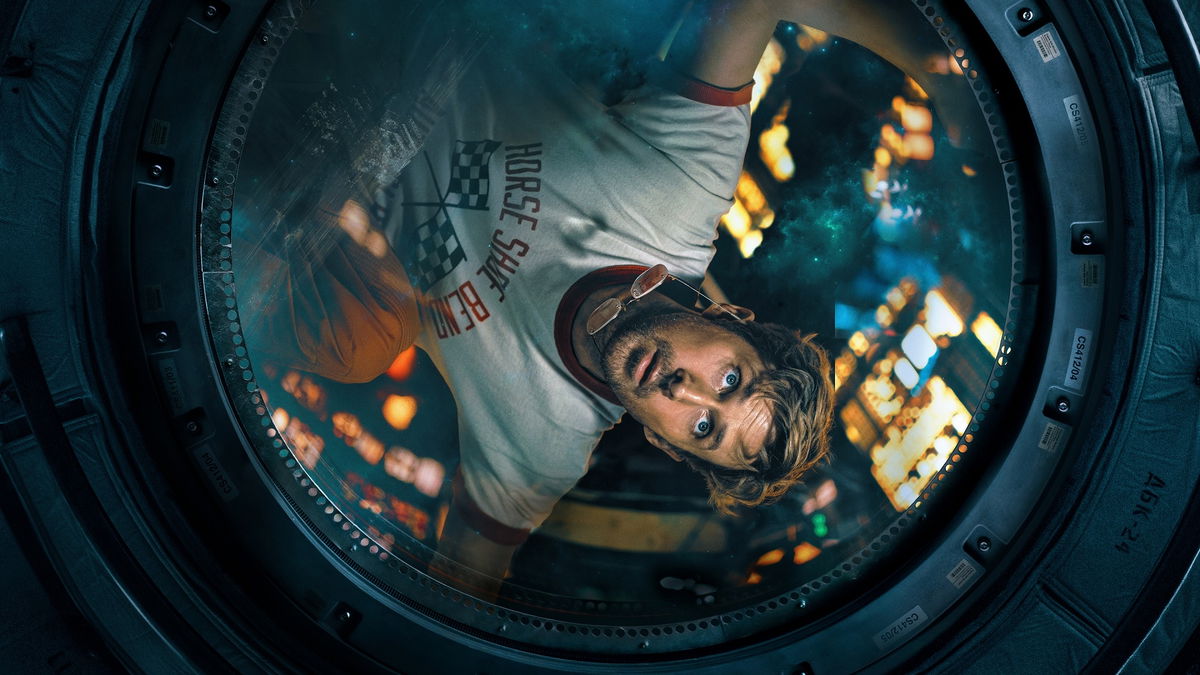
Scientific Spectacle and Practical Magic
Visually, the film looks to be a contender for the year’s best cinematography, thanks to Greig Fraser (Dune, The Batman). The footage showcases stunning “xenonite” structures and the “Petrova Line”—a glowing infrared arc connecting the Sun and Venus.
Technical details, a staple of Weir’s writing, aren’t being sidelined. From the centrifugal gravity of the ship to the selective breeding of “Taumoeba” (a predator for the sun-eating microbes), the film promises to reward audiences who enjoy watching a genius “science his way out” of a problem.
Cast and Production
Joining Gosling and Hüller is a robust supporting cast including:
Lionel Boyce as Officer Steve Hatch
Ken Leung as Commander Yáo Li-Jie
Milana Vayntrub as Specialist Olesya Ilyukhin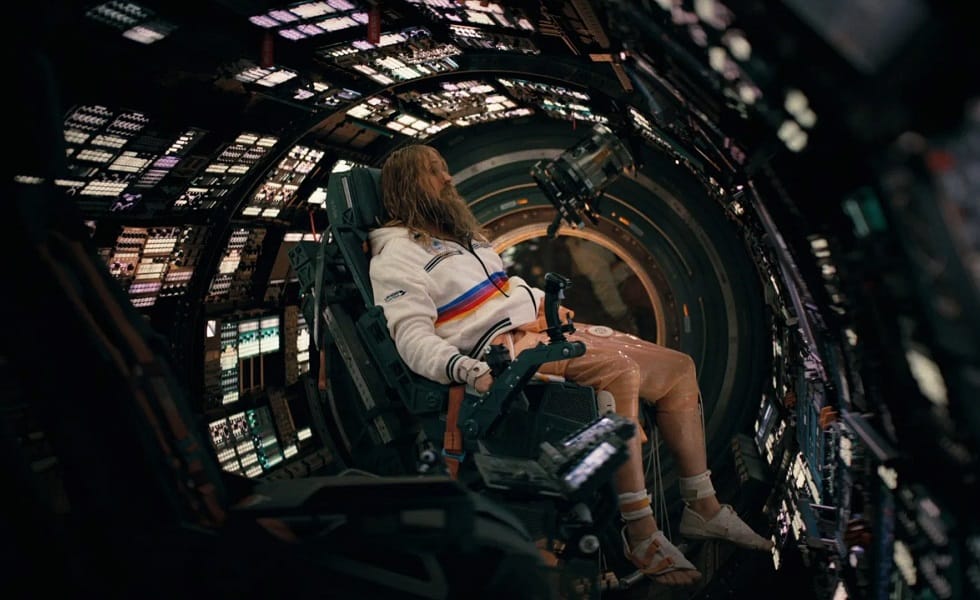
Produced by Amy Pascal and Gosling himself, the film has been under tight wraps since filming began in the UK in 2024. With a screenplay that reportedly trims the “scientific fat” of the novel to focus on the harrowing choice Grace must make between returning to Earth or sacrificing himself for his new friend, Project Hail Mary is positioned to be the defining sci-fi event of 2026.
As the sun dims in the trailer’s closing shots, the message is clear: the only thing more vast than the vacuum of space is the capacity for two different species to find a common language in the dark.